Categories
Events Our Network Program

Hack to shape the future of healthcare

Hack to shape the future of healthcare!


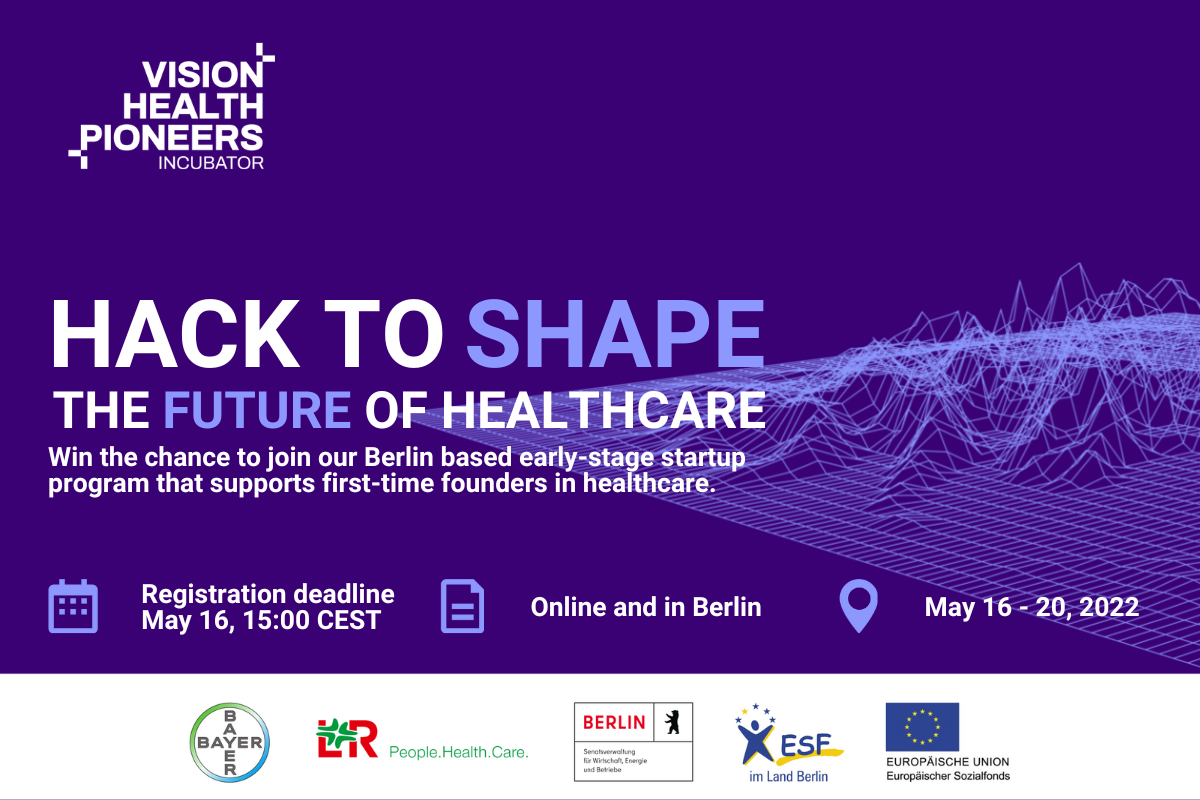
Vision Health Pioneers Hackathon May 16 – May 20.

We are eager to welcome you to this route to joining Vision Health Pioneers Incubator’s last cohort for 2022. This hackathon acts as your gateway into our 10-month startup program that supports first-time founders from Europe in launching their healthcare startups.

Register for the hackathon on TAIKAI

Teams that enter our Berlin-based startup program benefit from coaching sessions with experts in various disciplines, and mentoring from professionals who are leaders in their field of expertise, they will be introduced to our network and get access to our free co-working space at Unicorn Workspaces. We also support teams with equity-free, non-refundable scholarship funding of up to 20,000 euros per person. So your team, of up to 4 team members could win 80,000 euros in this hackathon! (Eligibility criteria applies).

During the hackathon we are holding workshops with some of our proven experts – so use the week-long hackathon to gain further knowledge and apply it to your startup. We also provide access to some of our great ecosystem of mentors who are there to support you in various areas. Dedicated expert mentors will also evaluate your team during the week. On the last day, Friday May 20 we are holding a Pitch Day, live from the virtual stage, so use this opportunity to wow the judges and make an impact.

Hack to shape the future of healthcare

  • The hackathon is open to those with pre-existing teams, teams who would like to find additional teammates (up to 4 per team) and individual entrepreneurs who are on the lookout to join a team that needs their skill sets and experience.
  • Startups that already applied via the F6S page for Vision Health Pioneers Incubator can and are encouraged to join.
  • At the end of the hackathon,  you can decide if you are ready to take the leap and start your own venture!


Join ‘Find our perfect match’ on Wednesday May 11, 2022 to find your teammates

If you are at the idea stage or have incorporated your idea, do not hesitate to pitch your project to your fellow hackathon participants, form a team and tackle the hackathon together. Please note if you have already incorporated your idea, certain eligibility criteria apply.

Join us online or in Berlin

For the last 48 hours of the hackathon, you are welcome to join us in Berlin at one of our coworking spaces. Every team that enters benefits from their own private project space in TaiKai (no one else will be able to access it) and in here you can exchange messages with fellow hackers, mentors and our Vision Health Pioneers Incubator team. We also have dedicated Slack channels to provide you with quick communications and updates.

Key links:

Categories
Our Network

Introducing the Vision Health Pioneers Incubator platform

Introducing the Vision Health Pioneers Incubator platform. It was somewhere around October 2021 that we received the news – Vision Health Pioneers Incubator was going to be extended for 2022/23. The following months leading up to the new year was filled with strategic planning, taking on learnings from the previous years and thinking ahead towards setting up and supporting our now more mature incubator.

Our program structure was updated with a new and exciting concept that allowed us to provide our teams with a more intense coaching experience, and with a smaller number of teams per cohort, greater tailored support. With teams having different tiers of experiences as they progressed through the program, we felt this increased the capacity for them to exchange and collaborate. Since January 2022, our incubator has opened the doors to two new cohorts boasting seven exciting startup teams. Come July 2022, we will welcome Cohort #5.

We are building upon the principles of collaboration and exchange, and in continuing to do so, are constantly finding new ways to power this. Our ecosystem is currently 150 experts strong with an ever growing community of alumni, mentors, coaches, and partners. In parallel, our incubator is nestled under the Startup Colours umbrella that supports other sister-ecosystems, such as the Applied Data Incubator.

We are growing, and to support this, the Vision Health Pioneers Incubator Platform was born.

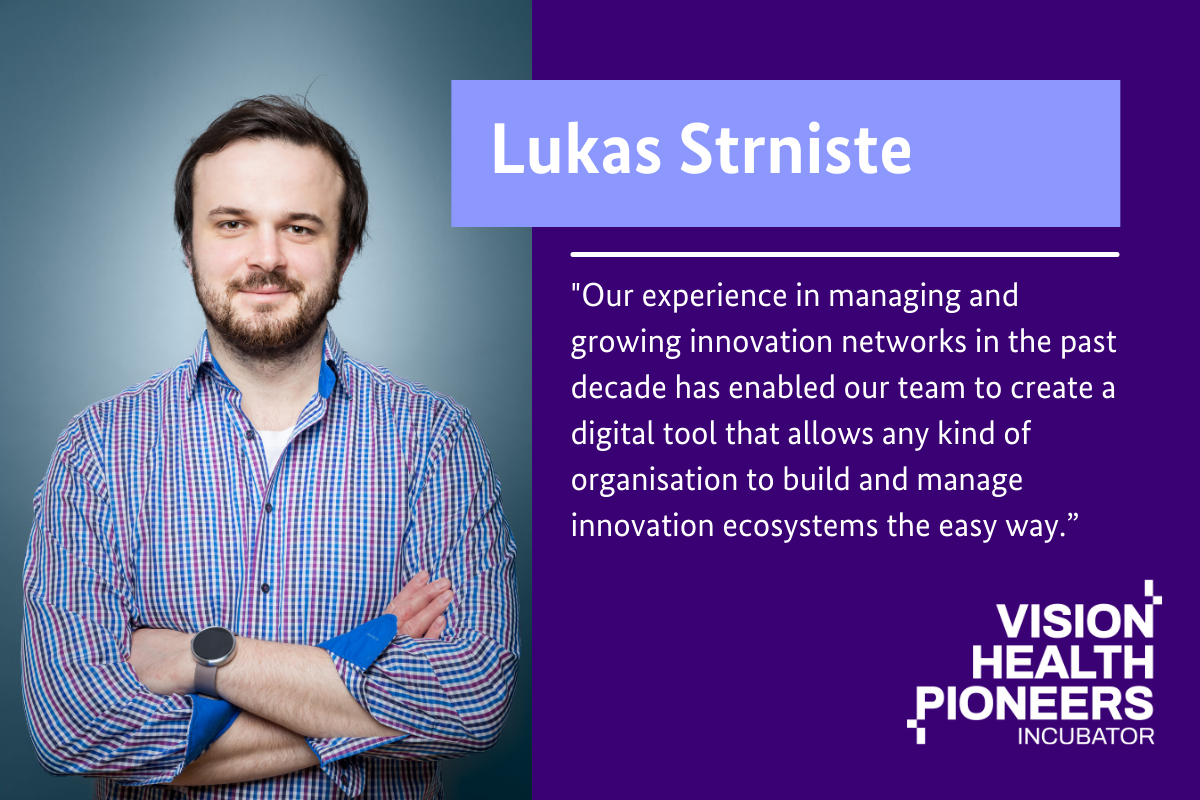
“EnterpriseUp is a collaboration platform for scalable innovation ecosystems. Our experience in managing and growing innovation networks in the past decade has enabled our team to create a digital tool that allows any kind of organisation to build and manage innovation ecosystems the easy way.”

– Lukas Strniste, Founder & CEO @EnterpriseUp.

Our ongoing collaboration with EntrepriseUp has allowed us to establish our very own virtual space that:

The platform is powered by EntrepriseUp, a Germany-based startup that builds bespoke collaboration platforms for scalable innovation ecosystems.

  • Allows our active startup teams to access and receive real time updates on our program. Our Knowledge Library also provides on demand access to workshop materials, and throughout the COVID-19 pandemic where in-person meetings have proved challenging, our teams have been able to jump into virtual workshops on our platform, via the embedded Program Calendar.
  • Provides peer circle spaces where exchange is able to take place. These assigned spaces regarding topics and projects allow for deeper, more meaningful conversations amongst like-minded individuals.
  • Drives our exclusive event and workshop initiatives.
  • Connect instantly. The platform with its direct messaging feature and notifications have allowed our community of mentors, coaches, alumni, startups and partners to have greater visibility on who and what they do, and create a touchpoint.

The fast-paced world of startup life is defined by the need to go with the changing tides. As an incubator committed to our vision to support the future of digital health, this platform is one of the ways we have evolved to manage, grow and nurture our community of thinkers and doers.

“We accumulated our expertise in a customizable white label solution that brings together people, knowledge, products, services, and data. Next step is introducing the “Ecosystems connect” module that will allow co-integrating operating ecosystems and building an interoperable network of globally connected innovation ecosystems.”

EntrepriseUp, in looking ahead, has been working towards introducing an Ecosystems Connect function. In the near future, the Vision Health Pioneers Incubator platform will be one pairing away from the other ecosystems EntrepriseUp supports. What this means, is that events and resources can be shared securely and with ease with communities outside of our immediate network. As our network expands, we are bringing people together. The heart of our incubator is our community, and the platform it’s home.

Visit the EntrepriseUp website or book a demo directly to learn how their platforms can generate value for you, your company, and network. 

Categories
Our Network

The need for more courage and visionary spirit

We were delighted to recently speak with Dr Reinhild Schwarte, Head of the Eating Disorders Department at Oberberg Specialist Clinic Konraderhof

In this fascinating interview we are given an insight into the numerous areas Dr Schwarte operates in and explore the current situation with eating disorder treatment for both patients and their close ones. We also look at future challenges and why innovation may be required. We thank Dr Schwarte and the Oberberg Specialist Clinic Konraderhof for their time. 

1. Please briefly explain your role and your company.

I head the Eating Disorders department at the Oberberg Specialist Clinic Konraderhof. The clinic for child and adolescent psychiatry, psychotherapy and psychosomatics at the Oberberg private clinics has three wards with a total of thirty-nine treatment places and ten adjoining day clinic places. The three wards are divided into a children’s ward and two youth wards. In the clinic, the entire spectrum of child and adolescent psychiatric disorders is treated in children and adolescents between the ages of five and twenty-one, provided that this can also be done without a protected person, accommodation is possible. The treatment focuses on eating disorders, obsessive-compulsive disorders, emotion regulation disorders, anxiety disorders, depressive episodes, school absenteeism and hyperkinetic disorders. The percentage of patients with eating disorders is 20-40%. A follow-up outpatient clinic with integrated home treatment as a treatment option is new.

2. How did you come to specialise in this field?

I have wanted to work as a psychotherapist with young people since I was 14. At that time, a psychologist at school really impressed me and I found the job exciting. In 2004 I was lucky enough to get a job with Professor Herpertz-Dahlmann in child and adolescent psychiatry at the University Hospital in Aachen. In the department there, the area of ​​eating disorders is one of the focal points of treatment and research. At that time, a multi-centre research project for the day-patient treatment of anorexia nervosa was being set up. As a young therapeutic assistant, I was offered the management of the project and accepted it. At the time, I was particularly impressed by the prospect of treatment of the serious illness that was closer to everyday life. During the course of the project, I was particularly impressed by how the treatment led to a holistic and comprehensive change for the patients: With an improvement in their nutritional situation, it was possible to get to know the patients better and better.This aspect is certainly the one that tied me to the special area.

3. One of our startups called aidable focuses on follow-up therapy by supporting the family of the person suffering from an eating disorder. They have personal experiences and therefore believe that there is a lack of support in this area. What do you think?

I think that every affected family would see it in one way or another. Our healthcare system is extremely focused on the individual patient, this also applies to children and young people. However, when it comes to mental illness, it is for two reasons important to involve the environment in the treatment. On the one hand, the environment often suffers massively: mental illnesses represent a massive stress factor on the environment around the person, the topics are often interwoven with shame and a feeling of guilt and there are too few social support options in our functionally oriented society. This often leads to subsequent problems that could have been prevented. On the other hand, it is often the case that a helpful and emotionally very committed environment can contribute to the maintenance of illnesses through insecurity or high emotionality.

4. Therapeutic follow-up can reduce recurrence rates – as much as 11% in some cases. How important are the people around the sick person for the recovery process?

In the case of eating disorders in particular, there is actually little leeway in this regard, as numerous studies have shown the relevance of treating the environment /family as well.

The environment can also have several relevant tasks with regard to the recidivism rate. For example, as the first instance of detecting a relapse, it can contribute to early intervention. Secondly, it is helpful to enable appropriate follow-up care in the healthcare system. Third, by making changes of its own, it can help create conditions conducive to recovery. We know that aspects such as motivation, eating training, social support etc. can reduce the recidivism rate. These aspects are of course also linked to the living conditions and the environment/ family.

5. What is your estimate of the burden and possibly psychiatric symptoms for key family members of patients with eating disorders?

Experience has shown that the burden on the relatives of patients is very high. The food and the medical condition of patients are especially two very existentially threatening aspects that understandably have a massive impact on the environment. Concern, shame, feelings of guilt arise, often power struggles as well, which come in the ambivalence of the illness are co-founded. A great deal of responsibility is still ascribed to the environment in the genesis of eating disorders. In my doctoral thesis I was able to prove that the parents of anorexic, adolescent patients are often characterized by a high degree of depression and that the communication of the affected families is characterized by a high degree of critical communication and emotional involvement. Both act as potentially maintaining conditions for the symptomatology. It can be clearly shown that more severe eating disorder symptoms are associated with greater depression and greater emotional involvement. This applies in particular to younger patients.

6. How do you see the care of people with eating disorders in general in Germany at the moment? What are the barriers, successful care methods/models, etc.?

As with many other mental illnesses, the care of those affected is often not sufficient and associated with long waiting times. In the case of eating disorders, this is particularly fatal because waiting times can go hand in hand with deterioration or even real life threats. In addition, the importance of early intervention for a good prognosis is well established. For those affected, the access options to offers of help are extremely confusing. You are extremely dependent on finding good advisors. Outpatient and inpatient therapy are established in Germany as care structures, and day-patient models are being added more and more. Innovative models such as home treatment, in which relatives can be involved much better in the treatment, which can be close to everyday life and inexpensive, have so far only been partially covered by health insurance and are associated with great organizational effort for the treating institutions. The bureaucratic access routes here are often very complicated. Better, more flexible patient care would certainly be possible if the therapists were allowed more personal responsibility with secure financing.

7. Innovation and novel solutions are in demand in many areas of healthcare and have become highly relevant for comprehensive treatment, do you also see this in your specialty?

The influences on the psychological wellbeing of the population are changing rapidly. Digitization, climate crisis, pandemic are three main factors that are immediately obvious to everyone, that everyone experiences and that are also easily verifiable in studies. It is actually only logical that these changes also require innovative new offers on the treatment side. So the challenges for the area of mental illnesses is still significantly greater than in other areas, but it is precisely here in particular that old structures are often retained.

The challenge in the implementation is often the recognition and financing by the health insurance companies. In Germany, we attach great importance to generally accessible health care, which also works well in most areas and ensures treatment. The supply systems often function in a very bureaucratic manner and are not very willing to change. I would wish for much more courage and visionary spirit here, as well as cooperation with universities to carry out pilot studies and the like.

Categories
Our Network

Meet the governmental backbone of the Berlin Startup Scholarship Program

They relentlessly support young entrepreneurs and make Berlin a powerhouse for startups – the Senate Department for Economics, Energy and Public Enterprises of the State of Berlin. Meet the governmental backbone of the Berlin Startup Scholarship Program.

We were delighted to speak with the leading forces behind the Berlin Startup Scholarship, Norbert Herrmann and Mirko Jäkel. Together with their colleagues they have created a framework which fuels Berlin’s growth in global settings. Berlin is renowned as a destination for innovation, but it’s their tireless efforts that’s behind why the German capital is the hotspot for entrepreneurialism. We explored more about how their efforts are modernizing the economy ecologically and securing and creating jobs. 

They are in many ways pushing the good ship of innovation forward with their activities – Making Berlin an attractive commercial and industrial location, utilising the reservoir of qualified and motivated specialists in and around the city and finding results in impressive creative diversity along with a high quality of life.

Meet the governmental backbone of the Berlin Startup Scholarship Program - Norbert Herrmann, Startup Affairs, Economic Policy Unit, Berlin Senate Department for Economics, Energy and Public Enterprises
Norbert Herrmann

Meet the governmental backbone of the Berlin Startup Scholarship Program, Mirko Jäkel, Policy Issues Startup Scholarship, Regular structural policy, Business Development; Berlin Senate Department for Economics, Energy and Public Enterprises
Mirko Jäkel

Norbert Herrmann, is very well known in the startup world. For some time he has tirelessly been one of the most active spokespersons for startups at a federal government level. He manages and supports large and small projects by creating enabling environments. He is joined by Mirko Jäkel who is equally integral for making things tick. They hold different roles within all the activity around the Berlin Startup Scholarship and are also quite different characters. Mirko operates in a specialised department and is responsible for framing the conditions for programs like the Vision Health Pioneers Incubator and essentially fueling them now and into the future. Norbert on the other hand has an overall view of the startups ecosystem and describes his role as “having a telephone and a Linkedin account. Through that I try to understand and listen and then translate startup activity into the thinking of the Berlin administration.” This also works the other way, so startups understand more about how things operate inside the Berlin Senate. They are modest in their roles but are both heroes behind the Berlin startup scene. 

Despite the differences in activity, Nobert and Mirko are united on one clear goal – to support startups in order to support Berlin. They are good spirited and both curious to always discover what’s working and isn’t working and how they can make things even better. 

Meet the governmental backbone of the Berlin Startup Scholarship Program – The Senate Department for Economics, Energy and Public Enterprises 


The Senate Department for Economics, Energy and Public Enterprises does not specialise in any single topic when it comes to startups. They focus on any solution that can help the city prosper and grow. Sectors of interest include healthcare but also energy transition, mobility, female entrepreneurs, green tech – any area that can help to build Berlin. Mirko describes more about this. “There are many excellent ideas in different fields being produced in the city. We have been really glad to receive extra funds from EU React so we could focus on the impact of Covid19 and on supporting solutions.” Vision Health Pioneers Incubator for example will continue for another two years after more than 3 million Euro of public funding has been invested. With the most recent support originating from a special European Union’s response to the Covid-19 pandemic.

Mirko continues, “What makes the Berlin Startup Scholarship so different to others out there is that it’s early-stage focused. The funding is provided at the idea stage, or as a prototype is being constructed. Other programs focused on latter stages of development. This is obviously great for the overall ecosystem, but we ensure startups don’t miss out on key information, such as how to go to market or enter the market as a first time founder.” The duo share how there are other pre-seed programs available but there are actually not that many in Berlin. 

Berlin has a renowned history with startups

On asking why Berlin has such a renowned history with startups, Norbert explains that there is no single answer but that the secret ingredient may be that Berlin is simply a cool place for young people. “Berlin has attracted lots of people, from all over the world, with crazy ideas and they have turned them into a reality. The famous startups successes are the likes of Zalando or Rocket Internet, who now operate in an alumni of businesses that were created and succeeded here. To be successful in the startup ecosystem takes time and Berlin was early enough to do this.” Norbert also emphasizes how there are other locations in Germany that have thriving startups ecosystems – however Berlin already has a wealth of contacts and that can make a difference. 

Norbert and Mikro agree that a healthcare program needs to be in Berlin due to how powerful the industry is in the capital. But what’s interesting to observe now is that in other sectors, the experts and investors are coming into Berlin to meet the startups. Norbert shares more on this. “The startups are here. So family offices for example are coming to Berlin to make connections to them. Even with finance – which you would think of as being housed in Frankfurt – most of the finance startups are here in Berlin.”

Both are clearly proud to be working in this area. They share warm smiles when discussing how the startups are being supported and how they help turn visions into realities. However it isn’t all completely perfect just yet as Norbert explains. “On the other hand I’m frustrated because a lot of good ideas are not being realised. They may not like the bureaucratic way that things need to be done or how the money available must be used in a certain way.” 

“We started in 2016 and the plan was to support 1,300 talents with a scholarship till the end of the funding period in 2023. With the last round now starting we’ll surely reach 1,800.”


Despite these feelings, Mirko shares how they have been succeeding with the majority of startups. “We started in 2016 and the plan was to support 1,300 talents with a scholarship till the end of the funding period in 2023. With the last round now starting we’ll surely reach 1,800.” This is an incredible achievement and despite the praise, both Mirko and Norbert are quick to say the praise is for the incubators and the startups. 

Experts in and around the Incubator


With the news that Vision Health Pioneers Incubator has been awarded another two years, Norbert says that the wealth of mentors and coaches the Incubator works with, makes a difference. “Knowing that healthcare professionals are involved in the Incubator means you really know what the problems are. We see that in nearly every successful incubator – they have a network of people who work or operate in that particular field. I hope in the future, various programs can share their knowledge or people in a way where if one is missing a crucial coach, another can support and provide this.” This evolution is an exciting vision for Norbert and their activity with the Berlin Startup Scholarship.

Berlin has many startups that are now fully fledged businesses and therefore Norbert questions whether the word ‘startups’ is even as relevant as it once was before. “Maybe the word will disappear. HelloFresh – which now is to be part of DAX40, the German index of leading shares – isn’t really a startup anymore, but is famed as being one. We may be saying ‘early stage companies’ and ‘grown up companies’ because it is different now to how it was before. But no matter the words used, we will always need innovative fresh ideas time and time again. To help Berlin continue to attract people. We as a department and administration will support that. We are drivers but we are not managing it. The programs are doing the best job and we must ensure we listen to them. For the small things and for the big things. We keep the ball rolling.”

Mirko adds a lasting point. “We hope in the future to have more and more solutions that solve problems we don’t even know exist yet. Startups grow into companies and in turn they hire more employees and we grow the economy from Berlin.” It’s an exciting future and with Mirko and Norbert leading the way, Berlin is set to continue to move forward into a thrilling future.


Categories
Our Network

What does INTO THE FUTURE mean for our community? Part 2

We have been asking our insightful community of supporters, mentors, coaches and partners what they think of when it comes to ‘Into The Future’? – For their thoughts on what innovation may happen in the near future, gaps that need solving in healthcare, what they can see in their crystal ball and more. We are thrilled to share their sharp, knowing and animating answers in part 2 of this series.
(Read part 1 here)

We are always fascinated by how our startups can find solutions to complex healthcare problems. At our INTO THE FUTURE Demo Day on 31st August 2021 the startups will present their businesses and explain how they solve issues for now and for the future. But we are equally as fascinating by what our community think of when it comes to the topic of ‘Into The Future’. Here are some of their answers…

Aline Noizet, Founder, Digital Health Connector

What do you think will be the biggest change in healthcare in the next 5 years?

Decentralized care! The care is going where the patient is, instead of the patient going to the primary care center or hospital. People are being more empowered and will be able to consume healthcare from wherever they want 24/7.

What kind of innovation do you want to see happen in the future of healthcare?

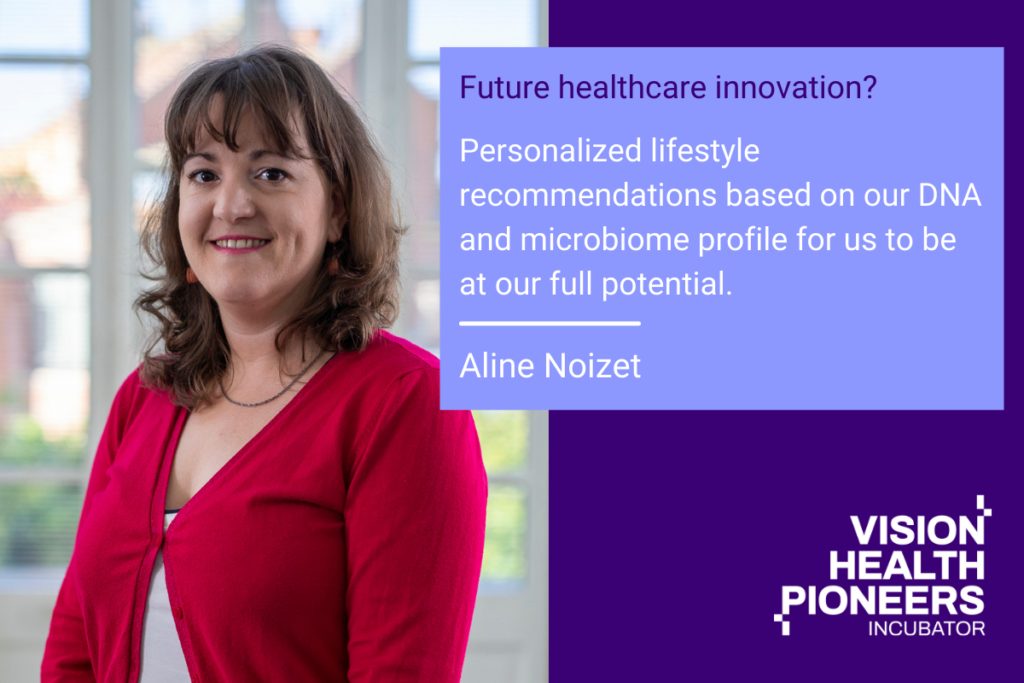
Monitoring innovation that will enable each of us to track our health continuously and take action early if needed. Those innovations should empower us and treat us as persons, so we understand clearly what is happening and the course of action to take, from prevention to cure. Personalized lifestyle recommendations based on our DNA and microbiome profile for us to be at our full potential.

Where are the gaps right now in healthcare that need solving first?

Regulation. Have a clear regulatory framework, coordinated and interoperable between countries.
Data sharing. Being able to access and process data in order to advance drug development, improve treatments.
Involve patients and healthcare professionals more in the development of technological solutions

What can you see in your crystal ball? What does Into The Future of healthcare mean for you?

Empowered patients! Patients as CEO of their own health, participating fully in the decisions made about their health and supported by the right tools and care team (human part is key!). Personalized treatment made for me!

What does into the future mean for you Aline Noizet Vision Health Pioneers Incubator


Michael Hübner, Projektmanager, Sana Digital

What do you think will be the biggest change in healthcare in the next 5 years?

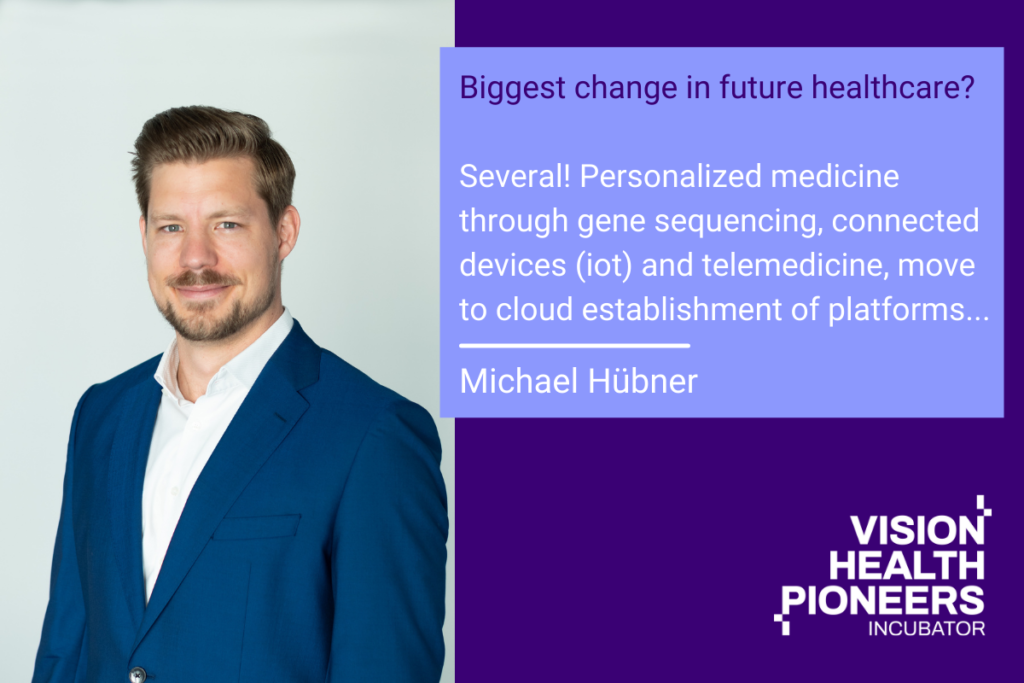
In my opinion there will be several big trends that will change healthcare as we know it in the next 5 years, such as personalized medicine through gene sequencing, connected devices (iot) and telemedicine, move to cloud, establishment of platforms, data and analytics for evidence based medicine, transformation from inpatient towards more outpatient care, rise of value-based healthcare, etc. Choosing one is difficult. – For the next 5 years I would assume that the establishment of an international market leading healthcare platform combining a lot of the earlier named topics for customers/patients will have the largest impact changing the delivery of healthcare throughout the continuum of care as we know it.

What kind of innovation do you want to see happen in the future of healthcare?

More value-based patient centric and evidence based healthcare replacing old procedures instead of adding on and thereby making healthcare not just more effective but also more efficient and economically sustainable.

Where are the gaps right now in healthcare that need solving first?

Education and primary prevention can have a large impact on population health and thereby lower healthcare spendings as well as improving public health and the quality of life.

If you could drop everything right now and create any related product or service – what would it be?

I would probably aim to team up with big healthcare payer and provider to create a digital platform integrating the concept of HMO and ACO to provide state of the art highly digitized affordable healthcare services to selected customer

What can you see in your crystal ball? What does Into The Future of healthcare mean for you?

I will improve healthcare on a systematic level as part of the digital strategy department of one Germanys largest integrated healthcare provider.

What does into the future mean for you Michael Hübner Sana Digital

Thank you to our community for sharing their insights. Find out more about our upcoming Demo Day – INTO THE FUTURE – on 31 August 2021.
Categories
Our Network

What does INTO THE FUTURE mean for our community? Part 1

What does our insightful community of supporters, mentors, coaches and partners think of when it comes to ‘Into The Future’? We asked a handful for their thoughts on what innovation may happen in the near future, gaps that need solving in healthcare, what they can see in their crystal ball and more. We are thrilled to share their sharp, knowing and animating answers. 

We are always fascinated by how our startups can find solutions to complex healthcare problems. At our INTO THE FUTURE Demo Day on 31st August 2021 the startups will present their businesses and explain how they solve issues for now and for the future.  But we are equally as fascinating by what our community think of when it comes to the topic of ‘Into The Future’. Here are some of their answers…

Dr. Hardy Kietzmann, Consultant in the area of digital therapeutics, focus Germany: DiGA

What do you think will be the biggest change in healthcare in the next 5 years?

Significant steps towards precision medicine (personalized diagnostics before selecting the drug).

What kind of innovation do you want to see happen in the future of healthcare?

Digital health passport or however you want to call it, … starting with (e.g.) german ePA and then enlargement on fields and features (much quicker than currently promised) and finally genetics to be included.

Where are the gaps right now in healthcare that need solving first?

Speed on ePA implementation and installment associated international standards including MIOs (again: toooooo late timeline for MIOs).

If you could drop everything right now and create any related product or service – what would it be?

I am on it (just joined a small StartUp). 8-))

What can you see in your crystal ball? What does Into The Future of healthcare mean for you?

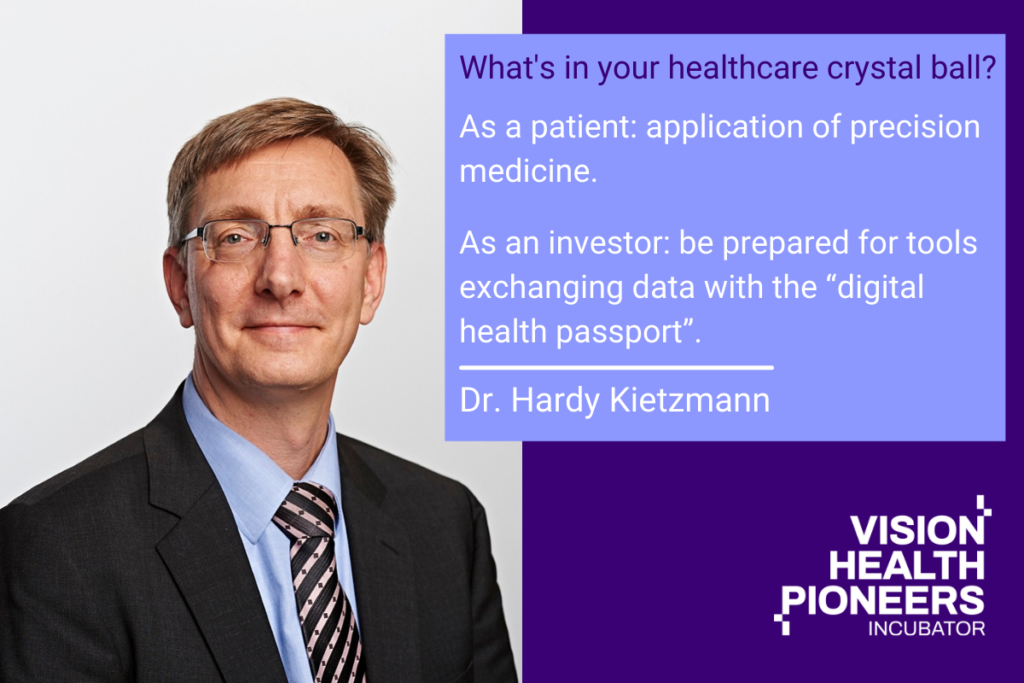
As a patient: application of precision medicine
As an investor: be prepared for tools exchanging data with the “digital health passport”


Dr. Hardy Kietzmann, Consultant in the area of digital therapeutics, focus Germany: DiGA

Kristin Memm, German Attorney at Law, Kanzlei KM

What do you think will be the biggest change in healthcare in the next 5 years?

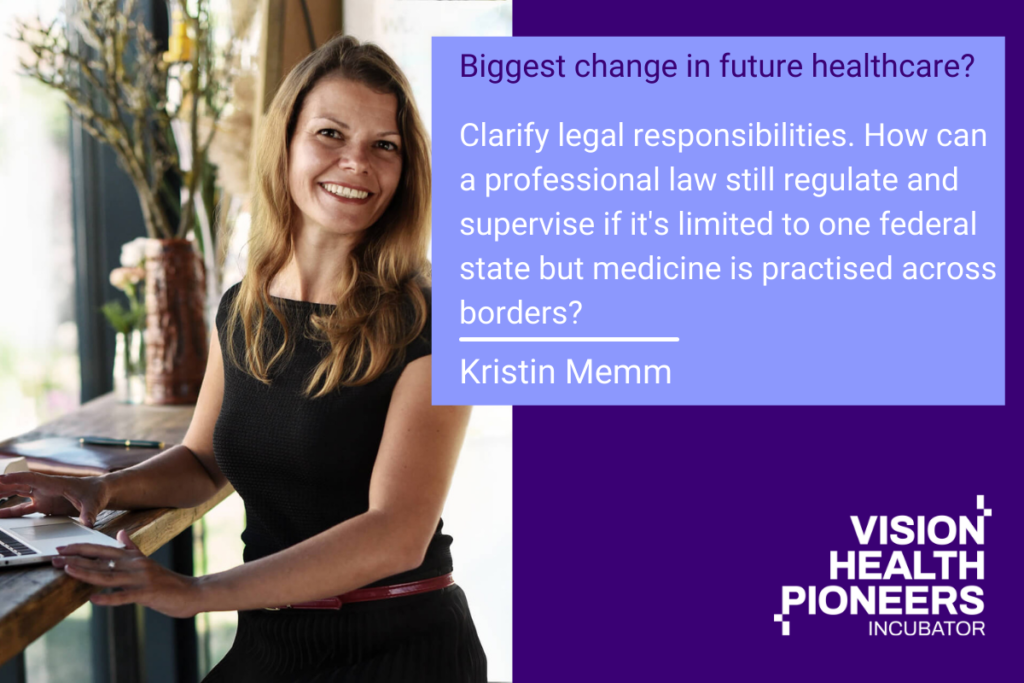
The centralisation of data. Artificial intelligence will collect such data, evaluate it and analyse it in a way that opens up new horizons for diagnostics, diagnosis, medical risk assessment and treatment decisions. The biggest challenge emerging from this will be to clarify the legal responsibilities.

How can a professional law still regulate and supervise if it is limited to one federal state but medicine is practised across borders? How can a physician be hold responsible for an AI making the right assessment of a treatment decision if the physician does not know the database and algorithms behind the AI? On the other hand, the AI is not a legal entity in its own right.

Our legal system faces a major challenge here. So far, we have set and changed the law in order to react to undesirable changes in our social community. Laws are abstractly general and are interpreted by the jurisdiction in individual cases. This results in the law by which we judge actions as right or wrong. The speed at which digitalisation is advancing is challenging our legal system in that law and jurisprudence are too slow to react to significant changes. Laws that only react to changes regulate a state of affairs that is often already in the past when they are enacted. The judgement of a supreme court is long outdated by the time it is pronounced. Our legal system is too slow and too limited to keep pace with technological development. This might cause an even bigger change in healthcare than the technical development. When technical evolution overtakes legal evolution, everything possible is also feasible, regardless of liability, responsibility and justice.

We need to rethink and make laws for the future. It will be crucial that we do not overstate the risks we see today, but also do not understate the risks that lie far in the future.

What kind of innovation do you want to see happen in the future of healthcare?

A patient centred healthcare, that focusses on prevention and the patients needs more than on treating diseases. The medical reimbursement system has become unbalanced in recent years. When financial incentives are set in such a way that it is not profitable to keep a healthy patient healthy, it becomes lucrative in an economically managed system to make patients sicker than they are. I hope, that the digital innovations, that mostly focus on prevention of chronicle diseases and serious health damages, change this approach and lead to a more individual, symptom controlled and health orientated wholistic healthcare.

Where are the gaps right now in healthcare that need solving first?

The medical reimbursement system needs to be changed fundamentally. Hospitals should not be allowed to be governed by stock exchange listed companies. The role of the physician as someone who shall drive healthcare innovation but must not be guided by economic interests must be reconsidered. In general we have to evaluate, who are our future healthcare providers, what drives them and how they are regulated. Medical self-governing bodies need to rethink their raison d’être. We all together should define the vision of our future healthcare and redefine our goals and mission for each healthcare body, each healthcare provider and each healthcare consumer.

If you could drop everything right now and create any related product or service – what would it be?

If I would drop everything for creating a healthcare related service it would be a patient centred App in non-hospital palliative care. With a focus on the therapeutic goal set together with the patient I would design a system that connects all doctors and nurses involved in the treatment, the patient and his or her caring relatives on the basis of a data-secure messenger service, provides access to the patient’s medical records and precautionary documents (such as the power of attorney for health care or advance directives) and that offers the option of requesting a multidisciplinary ethics vote in difficult decision-making situations.

What can you see in your crystal ball? What does Into The Future of healthcare mean for you?

This crystal ball is still very unclear and fuzzy. The future of healthcare depends on our ability to define a shared vision, critically review our existing systems and make the necessary changes, as well as our ability to abandon our retrospective assessment of current risks and exchange it for an objective prospective assessment of future challenges and regulatory requirements. If we can do this, the invention of digital health products has the potential to lead us to an ideal future of healthcare, where artificial intelligence can help provide the best valued and most individualised care, but where the patient, his or her health and a trusted doctor-patient relationship are at the heart of healthcare.

what does into the future mean for KRISTIN MEMM, GERMAN ATTORNEY AT LAW

Jeremy Dähn, Head of Digitization and Innovation, Johanniter

What do you think will be the biggest change in healthcare in the next 5 years?

Patients and healthy people out there will monitor their vital signs continuously, which will be analyzed in newly established data centers in hospitals. Hospitals can immediately react to incidents, relapses or even preventive care for healthy customers. Therefore the cross-sectoral borders will merge.

What kind of innovation do you want to see happen in the future of healthcare?

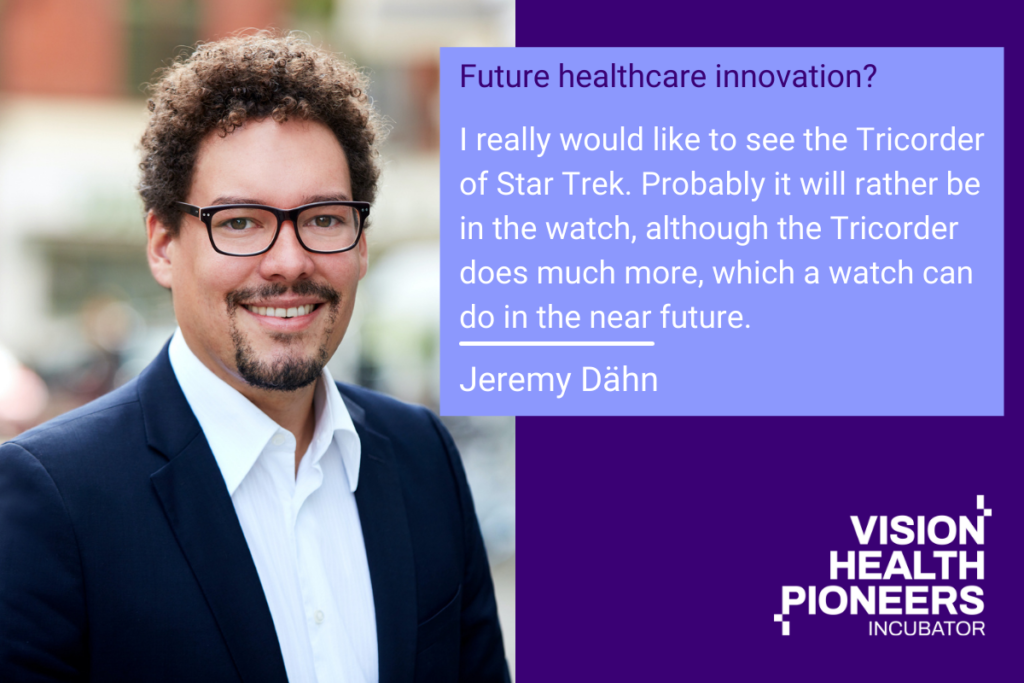
I really would like to see the Tricorder of Star Trek. Probably it will rather be in the watch, although the Tricorder does much more, which a watch can do in the near future. 🙂

Where are the gaps right now in healthcare that need solving first?

In Germany, it is still the regulatory part. The cross-sectoral borders are cumbersome for innovation along the patient journey.

If you could drop everything right now and create any related product or service – what would it be?

The Tricorder!

What can you see in your crystal ball? What does Into The Future of healthcare mean for you?

Healthcare will focus on three areas. Taking care of the healthy ones to stay healthy, curing people with one-time incidents like accidents and helping patients with chronic diseases to cope with their illness, fostering adherence, and support behavioral change.

What does INTO THE FUTURE mean for Jeremy Dähn, Head of Digitization and Innovation, JohanniterThank you to our community for sharing their insights. Find out more about our upcoming Demo Day – INTO THE FUTURE – on 31 August 2021.

Categories
Our Network

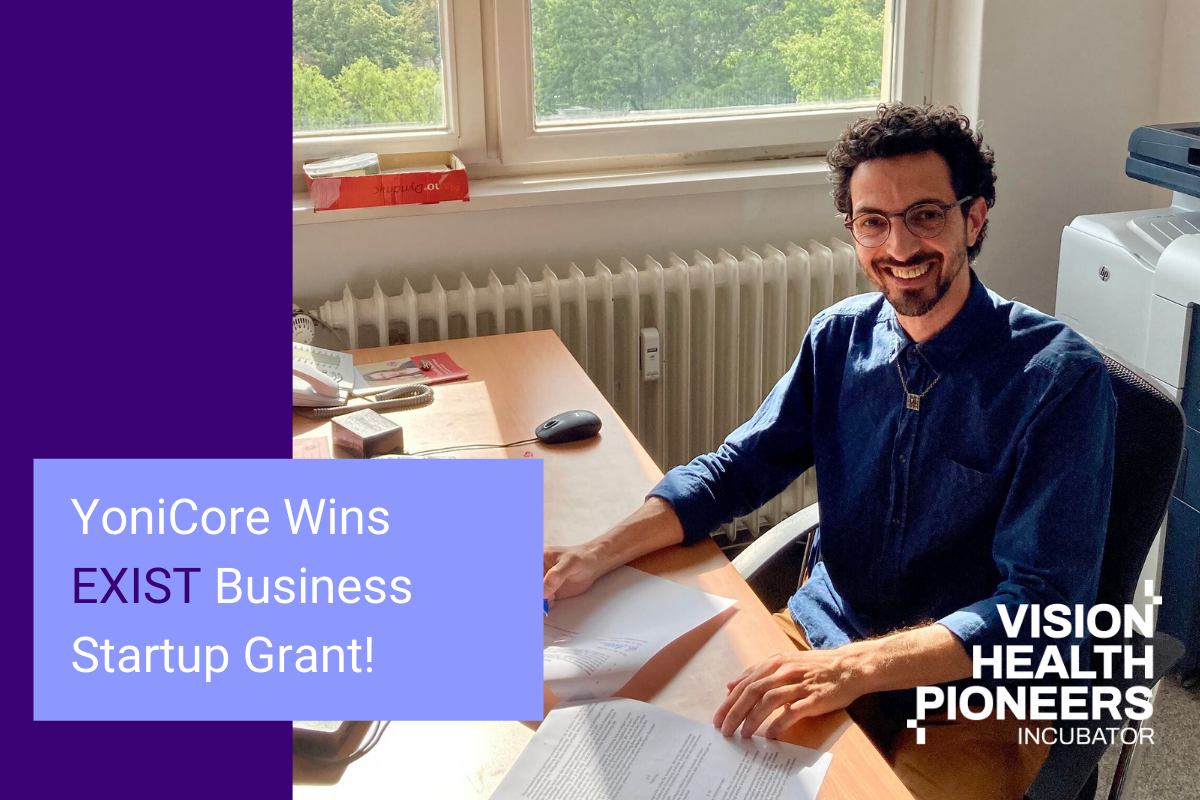
YoniCore Wins The EXIST Business Startup Grant!

“Well what can I say? It was hard work writing the application, but we had great preparation from Beuth University of Applied Sciences Berlin and then we won!”


Yair Kira, Co-Founder of YoniCore is modest when it comes to the amazing news that their startup YoniCore has won the EXIST Business Startup Grant. Supported by the European Union and German government, the grant is focused on start-up teams with innovative business ideas. Yair and his team signed the contracts and moved onto their next exciting step of their entrepreneurial journey. As is the life of a young startup in healthcare, it’s about building the business onwards. 

The Vision Health Pioneers Incubator alumni were awarded the grant, having pre-selected their mentor – Professor Ivo Boblan from the Compliant Robotics Lab in Beuth University of Applied Sciences Berlin (formerly Technische Fachhochschule Berlin). 

“We needed to have a research partner and after a few universities turned us down, we were introduced to Bastian Behrmann from Beuth University. We were invited to pitch in front of the Beuth Startup Hub team. They weren’t easy on us, but we were well prepared and each Co-Founder could answer about their field of responsibility. For example I remember how nice it felt when Linda Wonneberger, Co-Founder, could explain better than me about the market. While Hugo Silva, CTO, talked in detail about the technology and presented the prototype we built. It felt good to see how we compliment each other as a team and I guess this is part of how we won them as partners. They instructed us through the process and we wrote the application, which took some time because it needed to be in proper german!” Yair jokes.

YoniCore’s Mission

Part of the necessary components for securing the grant is being an innovative technology or knowledge based project with significant unique features and good commercial prospects of success. YoniCore with its mission to build an excellent product that will improve the lives of millions of women around the world certainly ticks this box. 

It however wasn’t all plain sailing. As Yair explains, “Due to the program structure, not all three Co-Founders could apply to the program. Therefore we decided to search for new team members for this application. This naturally took a little time but now we are happy that we could expand our product development team due to it.”

It was a three month wait and then Yair and his team received the news that they had been accepted. “It was a big milestone for us to reach. We were really happy.” The grant is for one year and supports up to three scholars per team. Yair explains that there is an allocation of the public money funds towards key areas. “It will allow us to develop the product further and gain more validations as preparation for the next round of investors talks and fundraising.” 

YoniCore’s Time With Vision Health Pioneers Incubator

Yair shares how their time, when they were named hers, in the Vision Health Pioneers Incubator helped prepare them for their overall journey. “It was almost a learning programme – we participated in many workshops. We were able to figure out all the health care issues we needed to deal with and came away from it with the ability to form our idea into a business model and plan.”

The team took part in the inaugural Vision Health Pioneers Incubator Demo Day.

“At our Demo Day in November 2020 it was another great milestone to reach. We were able to recap all the hard work we did and find the right way to communicate it. Our pitch was filmed and we still use that video today. It shows us and those in our network where we have been and where we are today.”


Yair also shares how the knowledge learnt through the Vision Health Pioneers Incubator has been of great support, even when this meant revisiting his notes. “We learnt how the German healthcare system worked and how to bring a medical product to market. At the time some parts felt theoretical and overwhelming. But now I can go back to my original notes and put those ideas into practice or re-tune something. After more than a year working on the project, we are gaining more hands-on experience and so we can match this with the theory. Slowly we are becoming experts in our field.”

Since Incubation with Vision Health Pioneers

16 AUG YONICORE WINS THE EXIST BUSINESS STARTUP GRANT!The time after the incubator with Vision Health Pioneers is key for all the startups. Yair recalls the conversations with investors that took place. “We had many talks and received feedback that the project and the team looked great, but that it was a little too early for them to invest. Now when we go into investor talks, we know what they need to know and would like to see.” YoniCore have set themselves a goal to be ready for talks once more by the end of 2021. “We are using the time to gather more medical evidence and how the treatment we offer from a medical point of view is needed.” Yair is confident there is a high demand of women who need and would purchase their product. Now they are making sure they have the evidence for investor conversations. 
Between the end of the incubator and the start of this grant, Yair and co have been taking part in other programs. “Tech4Ever, the mentoring programme, is specifically focused on women’s health and femtech so ideal for us. Another is Life Science Track which has been useful to analyze the user journey and requirements for quality management and the Medical Device Regulation (MDR).” Yair says. 

The team is now hard at work with developing their product further. “The opportunity we have with the University and the lab is to develop the product further. The difference for the other programs is that with the EXIST Business Startup Grant we have a budget for materials and services. This is  important when you develop a hardware solution. Now we have the possibility to get our product to work as we imagine it. After this we could test it and we’ll know what our minimum viable product (MVP) looks like. Then we can go through the CE certification and compliance  to the MDR.” 

The YoniCore Product 

The unique aspect of YoniCore’s smart connected medical device is how it treats pelvic floor dysfunctions. The individualized treatment is the only treatment that offers end-to-end relief with a long-term training programme within their app. Other products in the market provide either physical support and immediate treatment of symptoms, or pelvic floor training. YoniCore has a holistic approach that takes care of these women from all aspects and allow them to get more control with less visits to the doctor. Their focus is not just on the plain medical aspects but on the whole experience and taking into consideration the emotions and busy life of the women they are approaching. 

Categories
Our Network

Two More Years of Incubation!

We are delighted to announce that the Vision Health Pioneers Incubator will run for another two years! 36 entrepreneurs in 15 teams will once again receive support from our healthcare Startup incubator based in Berlin.

Check out these exciting new developments:


  • FUNDING: We will again invest more than 1.5 mio Euro public funding. This support originates from a special European Union’s response to the Covid-19 pandemic.
  • INVESTMENT: We will be able to grant up to 80,000 Euro per team equity-free funding (up to 4 team members).
  • ACCESS: To house our cohorts we just signed up for a new cribb: starting in 2022 we will partner with Unicorn Coworking and will offer our startups a modern space located in central Berlin.
  • TRAININGS: Stay tuned for even more coaching and mentoring from the best of the best in healthcare and beyond.
  • TIMELINE: Join us for an extended 10-month program
  • NETWORK: Connect with our network of 150+ experts via events and our growing Slack community


Note down the starting dates for 2022-2023:


Cohort #3 – Begin January 2022. Apply between 15.10.21 and 15.11.21.
Cohort #4
– Begin April 2022. Apply between 15.10.21 and 15.01.22.
Cohort #5 – Begin in July 2022. Apply between 15.10.21 and 15.04.22.

The challenge hasn’t changed but the paths of successful support are growing stronger by the day. Within the incubator our startups will learn how the German healthcare market works and how they can ensure that by the end of the ten month period of incubation, they are ready for their next steps. Now with two years of successful healthcare Startup incubation and an array of fantastic innovation solutions working their way into the healthcare ecosystem, or about to be presented to the world, Vision Health Pioneers Incubator is poised to support many more entrepreneurs achieve their dreams.

Keep a close eye across our social media channels and sign up for the newsletter to to be amongst the first to get notified once our application phase starts.

P.S.

Vision Health Pioneers Incubator Demo Day 31.08.21Our next Demo Day, INTO THE FUTURE, takes place on 31st August 2021! Get a glimpse of the healthcare startups currently in the program and meet the Vision Health Pioneers Incubator Alumni.

Join us from 15:00 until 17:00 for a fascinating and insightful look at how the startups have grown and developed. Please register for your ticket on Eventbrite and for the latest updates, click ‘Attend event’ on our dedicated LinkedIn page

We look forward to welcoming you!

Categories
Our Mentors Our Network

Mentor Johannes Steger on being present and owning your story

Johannes Steger is principal consultant and the current head honcho of communications at Plan D, a young technology and strategy consultancy actively shaping the face and experience of digitisation in the modern world, Plan D is Vision Health Pioneers’ most recent partner to come on board.

At ease in their spacious, industrial loft-style offices, Johannes is candid about the incredible journey of his career that has taken him from the buzzing tech startup scene of Tel Aviv as a journalist, to where he is today in Berlin. Despite having worked for many years as a tech journalist, Johannes humbly admits that his present role working with coding, engineers and data scientists has made him realise he knows nothing. That for him is an exciting revelation that he embraces as an opportunity to push himself out of his comfort zone. With this effortless capacity to step up to a challenge and an enthusiasm for all things tech, Johannes is a long-time champion of the startup community.

For him, startup culture poses as a powerful interrupter and driver of industry diversity.

The capacity of startup culture to birth forward-thinking founders and level the playing field through greater gender representation, is one that that he believes, “ultimately drives a country and the whole of Europe.

On Mentorship and Giving Back

“I think everyone who works in this ecosystem has the obligation to do something good. We all profit from this great Berlin ecosystem but living this startup life and being in this ecosystem comes with the obligation of giving something back.”

As a mentor at Vision Health Pioneers, Johannes has facilitated workshops on vision, stakeholders and messaging. He has also contributed his time and presence facilitating the recent Batch #2 pitch event. For Johannes, his involvement with Vision Health Pioneers is not just an extension of his love for technology and his belief in the integral role technology and data has and will come to play in the health industry. Rather, as a participant of the Berlin startup ecosystem, it is his commitment to building up and enabling others to drive the ecosystem further. As a natural visionary, there is a bigger picture and greater good that he is working towards in his guidance and mentorship of new startups.

“Vision Health Pioneers incubator is not only diverse by way of culture, but also the various solutions the startups bring to health. It is amazing that there is an incubator giving power and room for ideas that are finally bringing attention to stigmatised topics such as mental health and female intimate health”.


On Visibility, Being Present and Stakeholder Management

When it comes to networking, visibility and messaging, Johannes does not sugar coat the importance it plays for early startups. However, his core take-home message is simple: concern yourself with the needs of others, not just yourself. “Visibility can also mean being in an audience and listening. Being present, listening, learning and not necessarily always engaging. Just be there and learn. It is not always about talking and present by way of ‘presenting’ yourself but ‘present and listening’. This for me is essential for networking and visibility”.


Johannes Steger: 5 principles for building and maintaining stakeholder relationships


On Purpose, Messaging and Owning Your Story

There is a commitment to truth and integrity that Johannes stresses must be upheld from purpose through to the messages that are conveyed, particularly within the healthcare industry. Here, he is quick to draw the distinction between up-selling pizza and healthcare solutions. While there is an end-user in both instances, when it comes to health, it is important to bear in mind that a life is dependent on it.

“In communicating something about your product, you have to be very sure what you say and promise. Don’t promise anything you cannot keep, because even if the consequences of embellishment or false promise are not deadly, it is a pain that a person at the other end is feeling, be it a mental pain or a physical one”.

With regards to purpose, it is important for healthcare startups to not be solely profit-driven, but to be clear on what drives the innovation.

“With Vision Health Pioneers Incubator, every founder seems to have a personal relationship to the product they are building. When guiding the teams, I often tell them to use their personal story in their communications. It does not only have to be ‘I am suffering’, but it could also be, ‘I saw someone else’s suffering.”


At the recent Pitch event, his guidance was evidenced in the stories put forth by the young startups. Beyond open and honest, this authentic voice that Johannes encourages in communication is a bold declaration that gives a voice to invisible and stigmatised issues in healthcare. Putting these stories out there not only fosters connection. It holds the immense power to create dialogue, give hope and forge role models and leaders out of an idea born from one person’s story.   


Categories
Our Mentors Our Network

Mentor Laura Nelde on Berlin’s strong and supportive digital healthcare world

Hailing from Bremen, Laura Nelde moved to Berlin three years ago. A cherished mentor at Vision Health Pioneer Incubator, she’s Flying Health’s Startup Relationship Manager, where she works at the forefront of tomorrow’s healthcare, guiding industry leaders and entrepreneurs and working with startups in-house to develop new digital drugs. She holds an MPhil in Bioscience Enterprise from the University of Cambridge, and speaks passionately about the need for Germany’s wider healthcare community to embrace the technologies and treatments fostered in digital health.

You might also be curious to know that she’s pretty crafty and into DIY fashion. When she’s not working, she scours the web for designs and puts together all sorts of pieces using her grandmother’s sewing machine. As a mentor, she’s appreciated for her open mind, and stresses the importance of intellectual flexibility:

“I always say that what I am offering is one perspective, one piece in the puzzle. You have to speak to so many different people -there are so many stakeholders involved. There are many opinions you have to take into account.”

Curious to learn more on her story and values? Read on:


What do you think are the best steps to take to enter the digital health space?

When it comes to learning about the problem you are trying to address, It’s important to understand the traditional system and the current patient journey. You need to know which stakeholders are involved and how your proposed solution changes the current care path and offers value to all those involved.

It’s also a good idea to talk to experts: People who understand the healthcare system and people who have developed medical products before. Do not underestimate medical device regulations and consider that in your product development from the beginning,

And always keep in mind: the user might not be your customer.

What digital health issues are particularly on your mind at the moment?

Among my many interests, I’m motivated to tackle the subject of how to empower the patient by enabling a wide range of treatment modalities that includes digital solutions– besides traditional options including pharmacotherapy and face to face appointments. This is so that each patient is able to choose the type of care that is most suitable and most effective for them at that point in time.

It’s also important to me to support digital health startups In entering the market, so that they can make new solutions accessible to patients in Germany and allow innovations developed in Germany to stay here instead of leaving for opportunities abroad.

What motivates you to be a mentor?

I love sharing and passing on the knowledge and insights I have gained to support startups/teams that might be new to the healthcare sector. I’m passionate about bringing their ideas to reality as much as I am bringing innovation to the patients, the healthcare system is complex and without support, these endeavors can be difficult.

I also really enjoy meeting teams at an early stage and get excited about learning about new ideas with the potential to transform a part of care delivery. 

How would you describe the digital health space in Berlin– what are its relative strengths and weaknesses? 

Berlin’s digital health community is strong. Its startups rarely see each other as competition, but operate as allies working together to further develop digital health and make it an integral part of our healthcare system.

Before COVID, we also enjoyed all the opportunities we had to attend events and get to know startups and stakeholders. Though now, with COVID, our location is no longer our greatest asset. We’ve lost networking opportunities. But the flip side is that startups located outside Berlin can attend events here.

Did you always want to work in digital health, and if so, why?

I studied economics and management to keep my options open, but realized early on during my studies that healthcare was the area that fascinated me most. I wanted to work in an industry with a significant impact on people’s lives and the opportunity to make a change. 

Digital health, at the intersection of healthcare/medicine and tech had a lot of untapped potential, and seeing founders innovate in this highly regulated and traditional market has fascinated me ever since. This is because this path requires significant dedication and a strong vision and value proposition.

What personal qualities make the most effective founder in this space?

Some of the most effective founders we have met were those teams that combined expertise from science/medical backgrounds and business backgrounds.

This will likely not be a single person, but a founding team that has different backgrounds is tremendously helpful in understanding all aspects of what it takes to build a sustainable business while making sure that the proposed solution is addressing a medical need and built according to medical device and clinical evidence standards.

How do you picture the digital health space in Germany looking in five years?

I Imagine that the underlying national ehealth infrastructure will be widely adopted by then, building a strong backbone for new innovations to be developed and implemented.

I hope that many startups will continue to innovate and work together with existing players across sectors in healthcare to transform care delivery and improve outcomes.

I think there will also be a wide range of apps available on prescription that have become standard options across the treatment spectrum for physicians, and which will hopefully expand beyond the outpatient sector in supporting patients across the care continuum.

What cultural product would you take with you on a deserted island?

I’d want to have access to my favorite podcasts –then I’d have new episodes to look forward to! My top three podcasts are: Alles gesagt, Der Tag and Visionäre Der Gesundheit.

The community at Vision Health Pioneers Incubator goes far beyond its entrepreneurs and includes a diverse network of mentors. Read more about their stories and vision in our special series on them.