Categories
Our Network

The need for more courage and visionary spirit

We were delighted to recently speak with Dr Reinhild Schwarte, Head of the Eating Disorders Department at Oberberg Specialist Clinic Konraderhof

In this fascinating interview we are given an insight into the numerous areas Dr Schwarte operates in and explore the current situation with eating disorder treatment for both patients and their close ones. We also look at future challenges and why innovation may be required. We thank Dr Schwarte and the Oberberg Specialist Clinic Konraderhof for their time. 

1. Please briefly explain your role and your company.

I head the Eating Disorders department at the Oberberg Specialist Clinic Konraderhof. The clinic for child and adolescent psychiatry, psychotherapy and psychosomatics at the Oberberg private clinics has three wards with a total of thirty-nine treatment places and ten adjoining day clinic places. The three wards are divided into a children’s ward and two youth wards. In the clinic, the entire spectrum of child and adolescent psychiatric disorders is treated in children and adolescents between the ages of five and twenty-one, provided that this can also be done without a protected person, accommodation is possible. The treatment focuses on eating disorders, obsessive-compulsive disorders, emotion regulation disorders, anxiety disorders, depressive episodes, school absenteeism and hyperkinetic disorders. The percentage of patients with eating disorders is 20-40%. A follow-up outpatient clinic with integrated home treatment as a treatment option is new.

2. How did you come to specialise in this field?

I have wanted to work as a psychotherapist with young people since I was 14. At that time, a psychologist at school really impressed me and I found the job exciting. In 2004 I was lucky enough to get a job with Professor Herpertz-Dahlmann in child and adolescent psychiatry at the University Hospital in Aachen. In the department there, the area of ​​eating disorders is one of the focal points of treatment and research. At that time, a multi-centre research project for the day-patient treatment of anorexia nervosa was being set up. As a young therapeutic assistant, I was offered the management of the project and accepted it. At the time, I was particularly impressed by the prospect of treatment of the serious illness that was closer to everyday life. During the course of the project, I was particularly impressed by how the treatment led to a holistic and comprehensive change for the patients: With an improvement in their nutritional situation, it was possible to get to know the patients better and better.This aspect is certainly the one that tied me to the special area.

3. One of our startups called aidable focuses on follow-up therapy by supporting the family of the person suffering from an eating disorder. They have personal experiences and therefore believe that there is a lack of support in this area. What do you think?

I think that every affected family would see it in one way or another. Our healthcare system is extremely focused on the individual patient, this also applies to children and young people. However, when it comes to mental illness, it is for two reasons important to involve the environment in the treatment. On the one hand, the environment often suffers massively: mental illnesses represent a massive stress factor on the environment around the person, the topics are often interwoven with shame and a feeling of guilt and there are too few social support options in our functionally oriented society. This often leads to subsequent problems that could have been prevented. On the other hand, it is often the case that a helpful and emotionally very committed environment can contribute to the maintenance of illnesses through insecurity or high emotionality.

4. Therapeutic follow-up can reduce recurrence rates – as much as 11% in some cases. How important are the people around the sick person for the recovery process?

In the case of eating disorders in particular, there is actually little leeway in this regard, as numerous studies have shown the relevance of treating the environment /family as well.

The environment can also have several relevant tasks with regard to the recidivism rate. For example, as the first instance of detecting a relapse, it can contribute to early intervention. Secondly, it is helpful to enable appropriate follow-up care in the healthcare system. Third, by making changes of its own, it can help create conditions conducive to recovery. We know that aspects such as motivation, eating training, social support etc. can reduce the recidivism rate. These aspects are of course also linked to the living conditions and the environment/ family.

5. What is your estimate of the burden and possibly psychiatric symptoms for key family members of patients with eating disorders?

Experience has shown that the burden on the relatives of patients is very high. The food and the medical condition of patients are especially two very existentially threatening aspects that understandably have a massive impact on the environment. Concern, shame, feelings of guilt arise, often power struggles as well, which come in the ambivalence of the illness are co-founded. A great deal of responsibility is still ascribed to the environment in the genesis of eating disorders. In my doctoral thesis I was able to prove that the parents of anorexic, adolescent patients are often characterized by a high degree of depression and that the communication of the affected families is characterized by a high degree of critical communication and emotional involvement. Both act as potentially maintaining conditions for the symptomatology. It can be clearly shown that more severe eating disorder symptoms are associated with greater depression and greater emotional involvement. This applies in particular to younger patients.

6. How do you see the care of people with eating disorders in general in Germany at the moment? What are the barriers, successful care methods/models, etc.?

As with many other mental illnesses, the care of those affected is often not sufficient and associated with long waiting times. In the case of eating disorders, this is particularly fatal because waiting times can go hand in hand with deterioration or even real life threats. In addition, the importance of early intervention for a good prognosis is well established. For those affected, the access options to offers of help are extremely confusing. You are extremely dependent on finding good advisors. Outpatient and inpatient therapy are established in Germany as care structures, and day-patient models are being added more and more. Innovative models such as home treatment, in which relatives can be involved much better in the treatment, which can be close to everyday life and inexpensive, have so far only been partially covered by health insurance and are associated with great organizational effort for the treating institutions. The bureaucratic access routes here are often very complicated. Better, more flexible patient care would certainly be possible if the therapists were allowed more personal responsibility with secure financing.

7. Innovation and novel solutions are in demand in many areas of healthcare and have become highly relevant for comprehensive treatment, do you also see this in your specialty?

The influences on the psychological wellbeing of the population are changing rapidly. Digitization, climate crisis, pandemic are three main factors that are immediately obvious to everyone, that everyone experiences and that are also easily verifiable in studies. It is actually only logical that these changes also require innovative new offers on the treatment side. So the challenges for the area of mental illnesses is still significantly greater than in other areas, but it is precisely here in particular that old structures are often retained.

The challenge in the implementation is often the recognition and financing by the health insurance companies. In Germany, we attach great importance to generally accessible health care, which also works well in most areas and ensures treatment. The supply systems often function in a very bureaucratic manner and are not very willing to change. I would wish for much more courage and visionary spirit here, as well as cooperation with universities to carry out pilot studies and the like.
Categories
Inside the incubator

Supporting the supporters. Together without eating disorders – aidable

The road to recovery for someone who is suffering can be long, difficult and lonely. For those lucky enough to have family and friends around who can and know how to support them, it can make a huge difference to the recovery process. These supporters are an essential pillar, but are they forgotten about when it comes to their own health and wellbeing? Do we need to look at how we can support the supporters as well? Should they not be supported as well? This is where the startup aidable comes in. 

aidable hold a vision of “together without eating disorders” and that no one should suffer on their own. If recovery is viewed as a team process, everyone in that ‘team’ should be supported for the best possible results. 

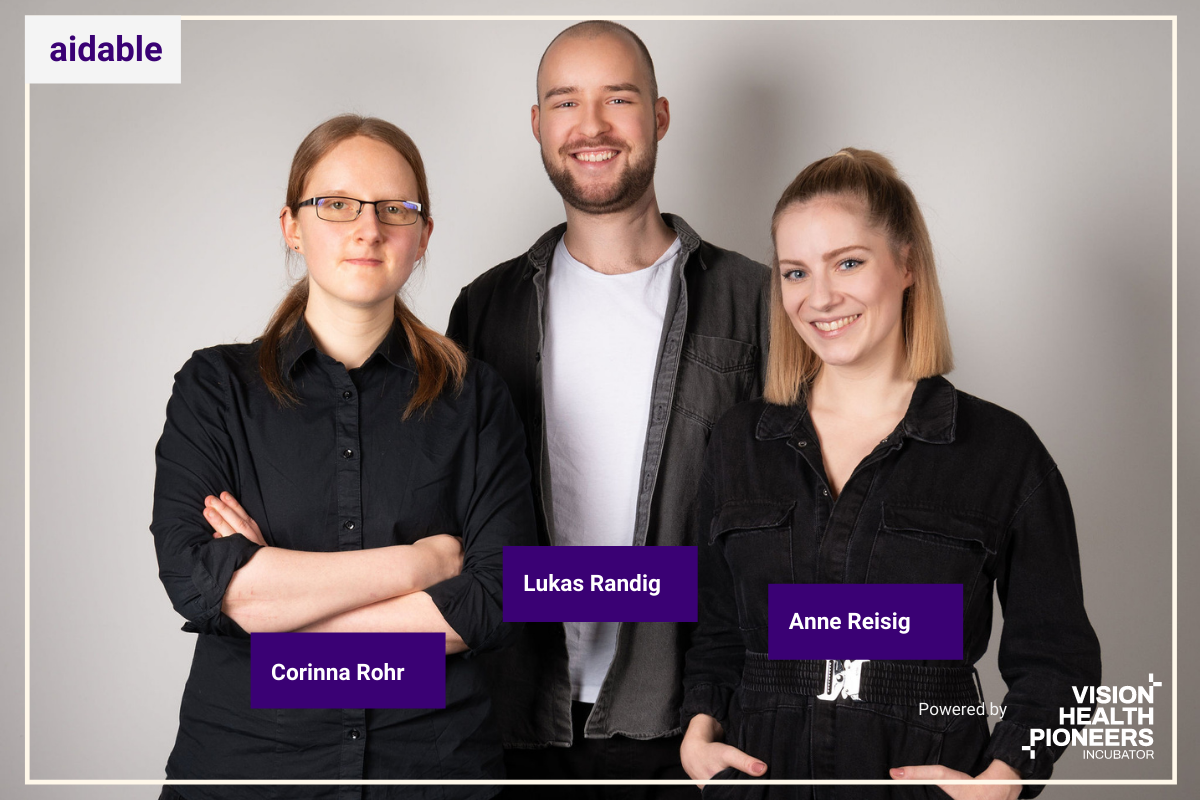
aidable is the vision of Anne Reisig who was inspired to do something from her own experiences. Anne suffered from an eating disorder in her late teens and even after she got better, she couldn’t stop thinking about what she had been through. These feelings have turned to drive and have led to aidable entering Vision Health Pioneers Incubator as a startup in the third cohort in 2022. Anne focused on this in her studies at University. “I really started thinking about doing something related to this area after handing in my bachelor thesis which received positive feedback. So I continued this in my master’s studies in UX and UI Design and Communication Management. Along the way I found a team who also cared about this topic.” 

candid shot of startup team aidable
Lukas and Anne of startup team aidable

This team Anne speaks of is Lukas Randig, who has experience in business administration, especially controlling and accounting and Corinna Rohr, a software developer. Combined, the team of three formed to power aidable to the next level and first met together in-person at deGUT, Germany’s largest trade fair for start-ups in 2021. Previously restricted by the corona situation, the team had worked online together. It was at deGUT that they met the Vision Health Pioneers Incubator team and would lead to them coming together in Berlin to attend the program. 

“We attended some great workshops at deGUT and were positively surprised to see some of the best ones were hosted by mentors within the Vision Health Pioneers Incubator community.” Anne explains before adding that whether inspirational figures they met at conferences or guest speakers whilst studying, the feedback they continuously receive is that the team is passionate about their topic and that they can make aidable into a solid, successful business.

Lukas Randig of startup aidable

As with any startup, first-time founders change their approach a handful of times. This is no expectation for aidable. What started with an original idea of a book, turned into an app. “We are always learning and trying to get better as a result of this. We now have an absolute focus for helping the relatives of those with eating disorders. But the way in which we do that is fluid. We don’t want to be too strict and our focus is to build a community. We want to do something that actually helps.” Anne explains before Lukas goes into a little more detail on this focus. “We were creating an app but we are currently working through what is the right tool, service or product to create – whether a web app, smartphone app, an online course and more. Nothing is set in stone. We want to develop something that people will use. At this stage we are asking customers what they want.”

Although early-stage, the team opening shares how they have failed at times during this process. “We tried sending messages to select groups of people on Facebook and hold online sessions but nobody came. We realised we needed to build trust and so took one step back and instead talked to everyone we knew. We asked if they were in contact with anyone who was suffering from an eating disorder and then directly and indirectly began to make personal connections. We found trust and started to hear answers such as “yes, I know someone.” We began to connect with parents whose children were suffering from these serious illnesses.” The team have clearly reflected and learnt from their experiences so far. “Corinna then had the idea of researching various institutions and clubs that tackle the topic of eating disorders.” Lukas adds. “We began to form connections with them and ask how we could help them, help their patients. We have now reached even more people.”

From a personal place.

Anne Reisig of startup aidable

When speaking to Anne today she is very open and it’s hard to imagine that at one point she couldn’t tell anyone about what she was going through for a long time. It is this personal experience that helps drive aidable forwards. “My parents found out after a year and my best friends after four years. It wasn’t until I began to present my bachelors project at university that I felt I needed to talk about it. A parent’s reaction may be to interrupt the eating disorder but part of the illness is that it wants you to stay sick and get even sicker. A relative may push the sufferer to eat but when you’re struggling and the sickness is telling you to ignore them, it wants you to continue to suffer until you’re dead.” It’s clear Anne had to go through something incredibly difficult. She adds, “I realise now that I didn’t have the energy to tell them and was desperate for an app that would have helped. If it could say to a parent how they should react. To not try and push their child to eat and instead work in a team. When a parent doesn’t have any input, it can cause conflict and turn relationships sour. If something like an app can support this and bring a family together, it can help everyone.”

Lukas, who has known Anne for some time, was part of her recovery journey. “I also have a relative who suffered from an eating disorder, so both experiences have made me want to do something with a purpose.” Lukas also explains how there is a stigma around eating disorders and this makes all three of them want to do more. “You can’t see a mental illness like you can with someone who has a broken leg. Equally people often don’t want to openly talk about it. But when we can open up, tell our stories and extend our trust, a safe protective space is formed.” Corinna also shares her personal experiences. “As a teenager I had friends going through the difficulty of eating disorders but no one ever explained more about it. What we should or shouldn’t do. Whether we should talk about something or not. I felt helpless and on reflection felt there needed to be an easier way to access knowledge on how to communicate and treat people.”

The unseen sufferer and supporter.

“Some people argue you can see an eating disorder, but if you are not very close to someone, you really can’t see it. Many of those with bulimia have a normal body weight. The sick behaviour only usually happens in secret. No matter what body type a person is, they may still eat tons of food and then throw up in secret. often surprise you who is suffering. In your close circles it can be helpful to know how not to trigger others. Triggers can be so easily done and begin with comments such as “I eat so much food at Christmas and now I can’t eat for a week” – without awareness, things like this can cause big problems.” Anne shares. 

Equally what the supporter is going through can be unseen. Studies have been conducted into the burden and psychiatric symptoms on key relatives of patients with eating disorders but is still relatively unknown. 

One of the main features of aidable is short concrete advice. Anne explains, “we realised you can find information online and in books on how to treat eating disorders but that information is very general. It lacks how to apply the information correctly and what relatives often want is simply solid advice. They want an answer to how they should react to a challenging situation.” It is this information that aidable plans to present so people can inform themselves in calmer situations. To make it easier to find professional help like therapy or inspiration – such as that with interviews of relatives of sufferers. 

Lukas explains that they also want to help the overall process of those who may need to go through rehabilitation. “When you are suffering from an eating disorder, you don’t always have the energy to call the bureaucratic powers between their phone line opening times. You may want and need treatment and rehabilitation but it’s a complex process.” 

Aidable hope to form close collaboration with health insurance providers or individual companies themselves. This could come in the form of programs that support the employees of a company.

Corinna Rohr of startup aidable

Whilst it’s still early days for aidable, they are enjoying being involved in the third cohort of Vision Health Pioneers Incubator. Corinna shares, “It’s been really nice to meet each other in person when possible. To talk to the other startup teams and get to know others.” Anne adds, “we’re extremely happy to be in this program. To be financially covered and really focus on our startup and not have it as only a side project.” 

They are a young team, but the three of them are enjoying the process of building something special. Anne thrives on interviews with the relatives of those who are or have suffered because it reminds her of why they are doing what they do. “I have so much energy after speaking with others and hopefully can give them advice. My goal is that even if we only impact just one person, it will all be worth it.” 

They will go far beyond this modest goal. But it does emphasise how aidable is focused on making as much difference as possible and completed in the best way possible. Although early into their time in the program, the team is benefiting from the insights from the coaches and mentors and working hard to make aidable as successful as those who interact with the startup know it can be.