Categories
Inside the incubator

You Have applied – What’s next?

Now you have applied to Vision Health Pioneers Incubator what happens next? Below are all the relevant information and dates for you to keep in mind for the selection process.

Jury Members

The Vision Health Pioneers Incubator selection process Jury is made up of healthcare, business and tech experts, as well as successful entrepreneurs. They have all been carefully chosen to evaluate the applications, based on their expert knowledge and select teams for the second batch.

Scoping Workshops: Show us what you got!

The scoping workshops are held online and are designed to last for 3 hours. Each team will have the opportunity to work on and develop the structure of their idea, as well as receive coaching from a Vision Health Pioneers mentor, to guide and support them during this ideation process. Even if your team is not selected to join the incubator’s second batch this process is extremely useful for the progression of your idea and building skills. 

By October 7th 2020 all teams who have applied, will know if they have been selected to join the Scoping Workshops. You will be provided with the date and time, however in the meantime please block the whole period from October 13th to 15th 2020 in your calendars to ensure your availability.

Team Interviews

If your team is successful in the Scoping Workshops you will be invited to Team Interviews. Again please block the whole period from November 2nd to 11th 2020 in your calendars to ensure you are available to join the interview on the selected date and time, which should last around 45 minutes to 1 hour. 

Waitlisted Teams

After being offered a position on the program, in the case that any teams are not able to join the program due to visa or other issues, teams that have been waitlisted will be contacted and offered a space on the program. In this case please be prepared in case we contact you.

If you have any questions regarding your application, please get in contact.

Categories
Inside the incubator

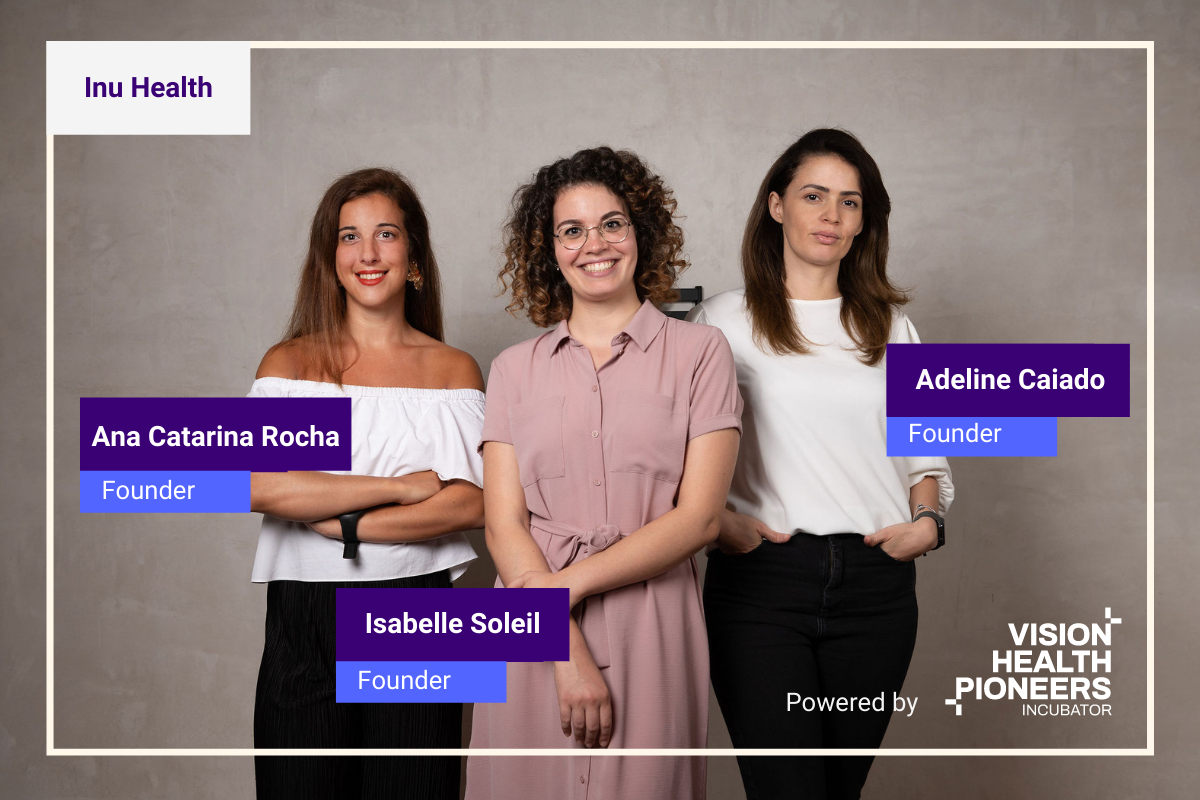
INU Health: Empowering women to find strength within and freedom from menstrual pain

From the age of ten, Adeline Caiado was tormented by excruciating menstrual pain, thinking– and being made to feel – that this was normal. 

Speaking of the experience now, the 31-year-old, soft-spoken Brazilian describes having to wake up on the first day of her period in such a state of agony as to have to lie motionless in bed for hours waiting for the painkillers to kick in, and for respite. Over the course of seven days, each month, she would have to endure what she describes as a sensation of having her insides twisted and squeezed at an intensity akin to being run over by a vehicle, and which spread itself beyond her pelvic area and through her intestines. 

She lived with this each month since her first period, which announced itself with a pain so intense she could not attend school for a week. Each year from that point onwards she would approach a doctor, asking if there might be something wrong with her, or if there was something she could do to make the agony bearable. Doctors all said the same thing. That this was normal. And that this was just what women had to go through each month.

“Not one doctor I went to suggested I might have endometriosis,” she recalls. “I had to learn about (the condition) myself.” 

The penny dropped when Caiado was watching a TV show of a doctor explaining the condition, in which tissue similar to that which grows on the lining of the uterus grows outside of it, causing a great deal of discomfort and also potentially resulting in infertility.

 It affects around ten percent of women, but, owing to long-standing taboos and misunderstandings around menstruation that are rooted in misogyny, it continues to be under-diagnosed and treated with indifference.

Owing to these attitudes, there’s often quite a lag between the onset of the condition and the time at which its sufferer is diagnosed, forcing many, like Caiado, to suffer in silence for years or even decades.

Two years ago, Caiado moved to Berlin. During that time, she tracked down a specialist in endometriosis, who diagnosed her with its most severe stage, prescribing surgery to remove the endometrial growths responsible for the distress. She went through this surgery last year, which, alongside lifestyle adaptations she made, helped tremendously. 

Caiado’s two-decade-long ordeal is not all that unusual, although awareness of the condition has grown in recent years, owing in part to more and more women finding the courage to speak out.

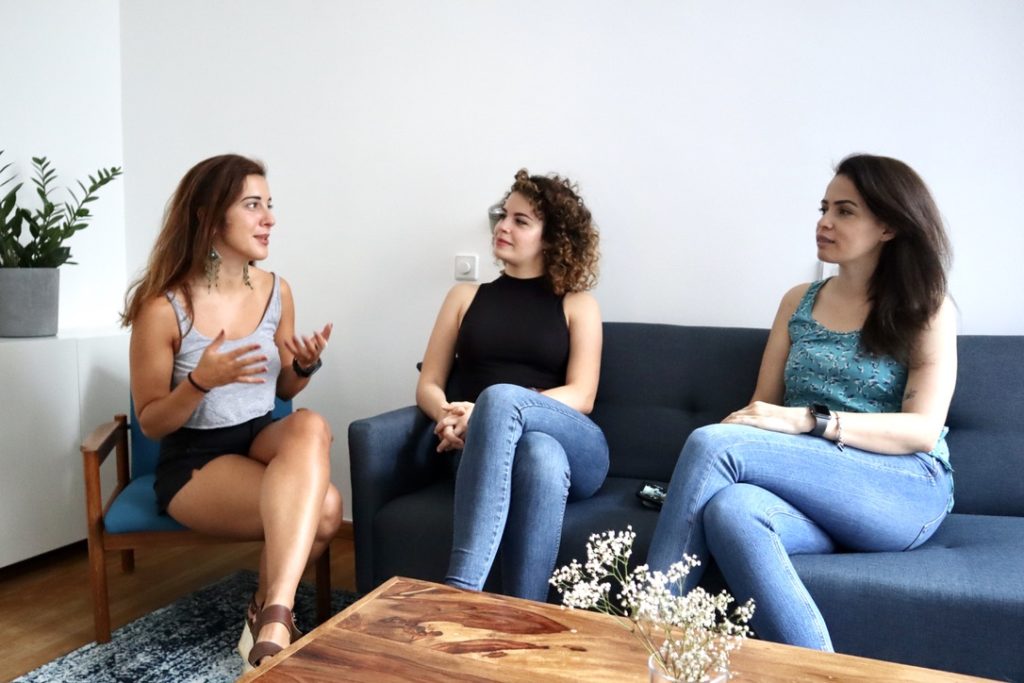
“We keep being told that this is normal. And if no one tells us its not normal, we’re just going to keep thinking it’s normal, telling our daughters its normal, and it’s not,” says Isabelle Soleil, a German/Belgian psychologist who makes up one third of Vision Health Pioneers startup INU Health alongside Adeline Caiado, who handles the marketing, and its passionate co-founder, Ana Catarina Rocha, who hails from Porto, Portugal.

“So we want to break the cycle and get people to talk about it. And for me, it’s been really interesting, because ever since I’ve started cooperating on this project, I’ve been talking about it more with friends. I feel like everyone knows at least one woman who has endometriosis, and they say “oh yeah, I didn’t realize how bad it was.”

Holistic solutions in the digital age 

The trio at INU Health aims to break the silence of endometriosis while providing practical solutions and holistic treatment via a sophisticated period tracker app that first offers a diagnosis, followed up by a 28-day-cognitive behavioural therapy programme alongside a host of holistic tips and tricks for managing pain. Its target audience extends past women with endometriosis, to encompass all women who suffer from painful periods in general.

The project, whose name derives from the idea that women have ample resources within themselves to heal and thrive, is the brainchild of Rocha, who did the work of joining various dots together, including one sparked during a chance meeting between her and Caiado in which the latter shared her experience with the condition.

“I want to give women the power of choice, through this app,” she says, describing how many women otherwise attempt to manage their pain through birth control pills, which can be problematic for the body.

Rocha has long wanted to explore holistic tools and strategies for empowering women, initially starting her journey at Vision Health Pioneers with a different female empowerment project, called Sista, which, owing to diverging visions between Rocha and her fellow founder at the time, split in June this year.

Rocha began looking more deeply into treatments for menstrual pain, discovering a research project in Australia that used cognitive behavioural therapy to help sufferers develop coping strategies. On a whim, Rocha reached out to the psychologist co-piloting the project, who was happy to offer insight and who remains in touch to advise INU Health. 

“I’m really fascinated with this psychology and how to trick the mind in order to change the state of the body,” Rocha says.

The missing piece, in the form of a Co-founder who could help helm INU Health while bringing deep insight into the mental health aspect of the project, was found in Isabelle Soleil, a psychologist introduced to Rocha by fellow Vision Health Pioneer’s entrepreneurs Mila.Health. 

Rocha and Soleil describe feeling an instant connection. Catarina offered her the role on the spot.

“Sometimes you have to use your mind and heart, and follow a little bit your intuition,” says Rocha.

As a trio, the INU Health entrepreneurs are excited about the road ahead, the possible avenues they can take their startup, and how their work can lead the charge in serving the large number of women who suffer needlessly and without support.

“I say this quote over and over again, but we only start working from a position of strength if we begin to embrace the way we are designed,” says Rocha.

For Caiado, embracing the way she is designed has come in the form of making big changes to her nutrition and lifestyle, which she can now do, being furnished with a much greater understanding of her own body and her condition. 

Her surgery was a success, and alongside a shift in diet – she avoids processed food, dairy, and gluten – and a host of insights accumulated via the app, her pain is nowhere near as intense as it once was, and she can live an unencumbered life.

“I feel really great now I have these solutions, and I know what is happening to my body. I don’t have extreme pain for days now, I just take one painkiller and that’s enough,” she says.

Categories
Inside the incubator

Advosense: The future of geriatric care is smart and patient-centric

Martina Viduka is not quite sure what it was that first sparked her untiring passion for geriatric care, but what she does know is that there has always been a part of her that has felt drawn to and inspired by older generations.

“It’s funny, I don’t know where it came from, this soft spot for the elderly,” she says. “I think it’s something about the wisdom they bring to society, and the work they’ve put in. I feel like a lot of our western cultures just don’t appreciate that enough.” 

Viduka’s fondness for the elderly prompted a career in nursing that lasted a decade, and which has provided firsthand experience and insight that has primed her for the next chapter of her life.

“I went into nursing because I wanted to somehow create a space, an age-friendly, caring space for people to age in the future,” she says. “I thought that nursing would be a good place to start, because you’re on the bedside and you really know and can see what was needed.”

Dreaming up revolutions in geriatric care

The whip smart and charismatic Croatian-Canadian is now one third of Vision Health Pioneers Incubator’s startup Advosense GmbH, having partnered up with co-founder, the Texas-born, Kentucky-raised Erin Webb in 2018. Webb brings to the table a fastidious, data-driven mindset alongside extensive management consultancy experience from working on projects for the Affordable Care Act.

As an entrepreneurial trio that includes British marketing specialist Grace-Anne Marius, their goal is to create the next generation of geriatric products. First stop: Smart incontinence briefs that use sensors to report to nurses when the patient needs to be changed. 

“Right now, it’s just not possible to know when a patient is wet or not. You have to go in and physically check and there’s no best practice,” says Webb. Their product, which currently has no direct competitor, features a passive and disposable sensor printed onto an incontinence brief which notifies the clinician when their patient is wet via their smartphone, tablet or computer.

The product stands to have far-reaching impact. Over 200 million people currently suffer from urinary incontinence, an affliction which can bring about a host of complications, including pressure ulcers, falls and urinary tract infections.

Introducing smart briefs into the workflows at nursing homes and hospitals would save significant time, allowing clinicians to better care for patients’ complex needs. No event has highlighted the need for adaptations like these to be made more than the current pandemic, which has exposed shocking deficiencies in healthcare systems globally.

“You need to deal with the basics first and have the right resources for the basic care so you can really deep dive into the geriatric special needs,” says Viduka. 

A winning combination 

Webb and Viduka first met at Maastricht University, while both were enrolled in a Master of Science in Healthcare Policy, Innovation and Management.

“We weren’t friends to begin with, but as the only North Americans on the programme, we had an eye for each other,” recalls Viduka.

“Towards the end of the programme, we ended up always on the same teams,” says Webb.

“…doing projects together, and killing them,” Viduka adds.

Advosense was born in November 2018, Berlin during hackathon ‘Hacking Female Health’ – an event powered by Vision Health Pioneers partner Hacking Health, when the pair joined forces and worked as part of a team called PeriPower.

“Martina and I were sitting next to each other and I was, like, “Martina, you have to pitch something about geriatrics. Otherwise, all of these solutions are going to be about other problems that are not as inspiring to you,” recalls Webb.

PeriPower emerged victorious, a success prompting the pair to consider taking their idea to the next level. Fast forward a couple of years, a place on Fraunhofer’s AHEAD programme, a name change and now as part of Vision Health Pioneers Incubator’s first cohort, the team have set their sights on eventually bringing their product to German hospitals and nursing homes, with a view of later pitching to North American and more European markets.

But that’s still quite far down the line, as a lot of expensive processes involved in bringing medical devices to market – and making sure they are safe, effective, and usable  –  lie ahead. Two big challenges present themselves now: finding funding and validating the product. 

Ingredients for the long road ahead

For now, the team has some time to reflect on the journey they have taken, where they are going next, and how Vision Health Pioneers Incubator has helped them along the way.

“Now that the programme is eventually coming to an end, I feel like a chick getting ready to leave the nest and I’m starting to get a little nervous about it,” says Viduka, who lists the mentorship and community-spirit at the incubator among its many perks. 

“[The programme] really gave me the courage to move forward. Before, I felt… imposter syndrome, I guess. I still kind of do. So, it gave me the support and the tools to feel that I can do this.” 

Webb agrees that the convivial spirit and guidance has been a big help, especially in managing the uncertainty involved in building something completely from scratch.

“I think that a lot of the mentorship and also being able to talk to the other teams who are going through the same thing has been very valuable,” she says, adding that the incubator’s flexibility and resilience from lockdown onwards has also been much appreciated.

It’s been an important time for the team to set upon the values that they believe will carry them through each new challenge that presents itself along their journey to revolutionising geriatric care.

“Erin and I laid out the qualities and characteristics that we’re looking for as a team, as our team grows. Resilience was one of the top ones. What else?” asks Viduka.

“Autonomy, trust, curiosity,” says Webb. “And commitment to the vision. Because it’s very important to really always be able to go back at the end of a hard day and say, “Okay. What’s driving this?” I would say that that’s essential for an entrepreneur”. 

While the pair think about what lies ahead for Advosense, they are also keen to consider the twists and turns that brought them to where they are now, and the extent to which keeping an open mind has helped them both discover and adapt their mission. 

That openness to seizing new opportunities as and when they arise is what led both women to joining forces, turning a lifelong dream to transform geriatric care into an actionable mission, and finding inspiration, mentorship and a community along the way.