Introducing the Vision Health Pioneers Incubator platform. It was somewhere around October 2021 that we received the news – Vision Health Pioneers Incubator was going to be extended for 2022/23. The following months leading up to the new year was filled with strategic planning, taking on learnings from the previous years and thinking ahead towards setting up and supporting our now more mature incubator.
Our program structure was updated with a new and exciting concept that allowed us to provide our teams with a more intense coaching experience, and with a smaller number of teams per cohort, greater tailored support. With teams having different tiers of experiences as they progressed through the program, we felt this increased the capacity for them to exchange and collaborate. Since January 2022, our incubator has opened the doors to two new cohorts boasting seven exciting startup teams. Come July 2022, we will welcome Cohort #5.
We are building upon the principles of collaboration and exchange, and in continuing to do so, are constantly finding new ways to power this. Our ecosystem is currently 150 experts strong with an ever growing community of alumni, mentors, coaches, and partners. In parallel, our incubator is nestled under the Startup Colours umbrella that supports other sister-ecosystems, such as the Applied Data Incubator.
We are growing, and to support this, the Vision Health Pioneers Incubator Platform was born.
“EnterpriseUp is a collaboration platform for scalable innovation ecosystems. Our experience in managing and growing innovation networks in the past decade has enabled our team to create a digital tool that allows any kind of organisation to build and manage innovation ecosystems the easy way.”
– Lukas Strniste, Founder & CEO @EnterpriseUp.
Our ongoing collaboration with EntrepriseUp has allowed us to establish our very own virtual space that:
The platform is powered by EntrepriseUp, a Germany-based startup that builds bespoke collaboration platforms for scalable innovation ecosystems.
Allows our active startup teams to access and receive real time updates on our program. Our Knowledge Library also provides on demand access to workshop materials, and throughout the COVID-19 pandemic where in-person meetings have proved challenging, our teams have been able to jump into virtual workshops on our platform, via the embedded Program Calendar.
Provides peer circle spaces where exchange is able to take place. These assigned spaces regarding topics and projects allow for deeper, more meaningful conversations amongst like-minded individuals.
Drives our exclusive event and workshop initiatives.
Connect instantly. The platform with its direct messaging feature and notifications have allowed our community of mentors, coaches, alumni, startups and partners to have greater visibility on who and what they do, and create a touchpoint.
The fast-paced world of startup life is defined by the need to go with the changing tides. As an incubator committed to our vision to support the future of digital health, this platform is one of the ways we have evolved to manage, grow and nurture our community of thinkers and doers.
“We accumulated our expertise in a customizable white label solution that brings together people, knowledge, products, services, and data. Next step is introducing the “Ecosystems connect” module that will allow co-integrating operating ecosystems and building an interoperable network of globally connected innovation ecosystems.”
EntrepriseUp, in looking ahead, has been working towards introducing an Ecosystems Connect function. In the near future, the Vision Health Pioneers Incubator platform will be one pairing away from the other ecosystems EntrepriseUp supports. What this means, is that events and resources can be shared securely and with ease with communities outside of our immediate network. As our network expands, we are bringing people together. The heart of our incubator is our community, and the platform it’s home.
Visit the EntrepriseUp website or book a demo directly to learn how their platforms can generate value for you, your company, and network.
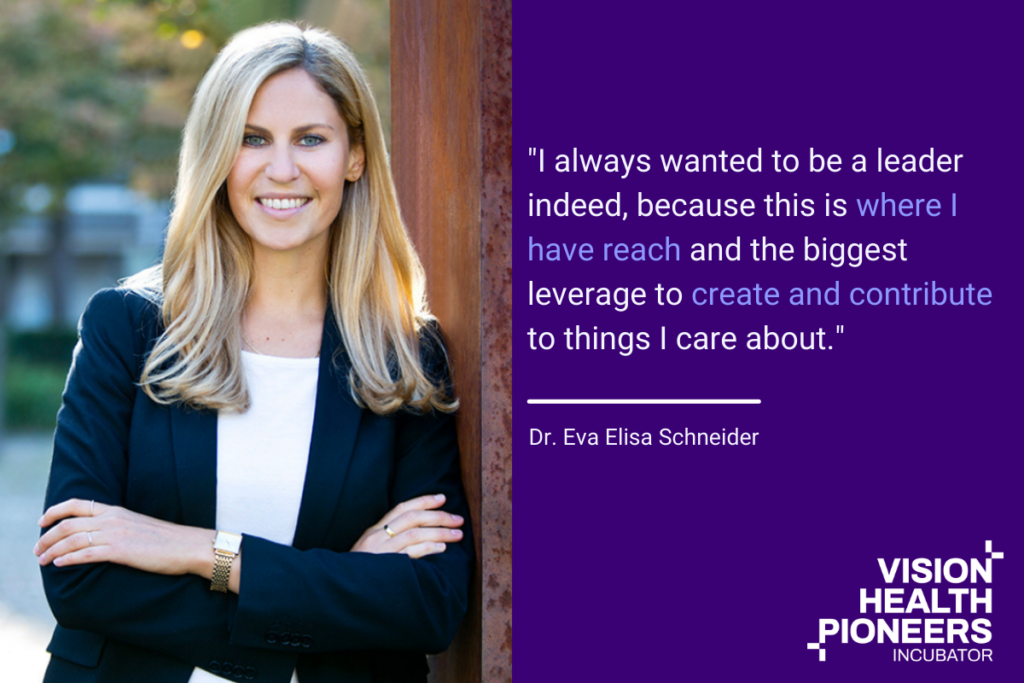
Dr. Eva Elisa Schneider is a mental health expert, psychotherapist and coach. She is the Founder of the mental health lab that supports individuals, teams and organisations in the creation of a people centred and needs oriented culture. A passionate advocate for mental health, Eva views it beyond the ability to meet everyday challenges in coping with stress in a non-harmful way. Rather, she sees it also as the psychological and behavioural flexibility to take on opportunities to grow and contribute within someone’s scope of action.
Unsurprisingly, she is also the team lead of nilo.health. Alumni’s of our Cohort #1. nilo.health is opening up the space for mental health in the workforce. Bringing counsellors, therapists and mental health content on one platform, nilo.health is empowering employees to be proactive and take charge of their mental health.
What issues or topics are you most motivated to tackle and what Digital Health issues are particularly on your mind at the moment?
First, bringing together mental health care and digital solutions. Mental health is a sector which has been practiced in a very traditional way for decades, however, the Corona-pandemic has promoted people’s acceptance towards digital mental health solutions. People started to realize that digital healthcare is actually beneficial and can come with many advantages, e.g. location independence.
Second, motivating health professionals for using and recommending digital health solutions themselves. Many professionals stick to their usual day-to-day routine and don’t directly realize the huge added value of digital health products. Health professionals are the crucial bottleneck when it comes to stakeholder management, which is why I believe we have to show them how digital solutions can spark joy. As Marie Kondo would say!
Third, making digital health solutions accessible and easy to use for everyone, including people that haven’t been in touch with any mental health support before or generations that didn’t grow up with an intuitive understanding of digital devices and solutions.“
What advice would you give your younger self?
Always pay attention to your gut feeling! And that you don’t have to stick to prototypical career paths, even if many people suggest you to do so – it’s a great character trait to stay curious and to have many interests. Many people kept telling me that I should finally focus on one particular direction, but this always felt very limiting. Being active in many different projects and engaging in things I care about is a huge strength of mine and I would tell my younger self that this is a great skill and not a weakness.
What is the best advice anyone ever gave you?
You have to find your very own way.
Who is your role model/mentor and why? What are the qualities of an effective mentor especially in this space? What motivates you to be a mentor?
For a very long time I was looking out for role models that have walked a similar path like me and are active in the digital (mental) health sector now. Meeting a licensed psychotherapist in the digital health space is still rather rare, but there are a few now, which feels very refreshing and it’s a great experience to connect with them.
At this point in my life, it’s a big motivation to show other people from my profession that leaving the typical psychotherapy and science career path is perfectly possible and a great option to pursue, even if it might puzzle some people. This is also what I tell my mentees: If it feels right, stick to the very individual pathway you are going!
Having been both a mentee and a mentor myself, a huge motivation for me is to give something back. I have received a lot of valuable support in my life so far, and I believe that whenever you receive something, it’s important to give something back somewhere else.
A mentor has to be a reliable sounding board for whatever topics come up. I believe that mentoring is not limited to time, positions or programs, it’s a trustworthy relationships that exists beyond respective borders.
How would you describe or characterise your digital health journey? Did it have big highs and lows, and if so, how do you feel about those experiences, now?
I have experience in inpatient and outpatient care, in health science, in the digital health sector and as an organizational consultant. All those different lenses help me to understand pains and needs from various perspectives. The classical health sector is often characterised by very strict guidelines, slow processes, complicated workarounds and few financial resources, which felt like navigating it with the brakes on. Yet, our current healthcare system provides a lot of safety, which is of course beneficial when it comes to anything around health. In the classical health sector, you are often confronted with a “no” or a deprioritization whenever it comes to anything digital, often because of financial reasons or because people fear they might destroy all the routine processes that were built over years and years. In the private sector on the other hand, people have a bigger credit of trust for innovation and new ideas.
When I entered the digital health space I was amazed by how fast things are being implemented, tested and refined. The mindset is completely different and a lot more agile: Get your product out, test and iterate as often as possible, learn by exploring, not by discussing everything in theory.
The pace in how ideas and products develop is so much faster and the willingness to take a risk is higher, which was a huge game-changer for me. Despite all the differences, I also see a common goal: anything that will help people in the long-run is a key motivation!
Explore how nilo.health is making mental health support easy for your entire organisation
What have been you biggest challenges in working through a pandemic, and have you found any silver linings?
The pandemic hit me in waves. At the beginning in 2020 I had huge boost in creating new concepts and making a virtue of necessity. For example in my lectures I was teaching therapy and conversation techniques, so I was wondering how in the world I am supposed to translate something so analogue into the digital space. However, there was no alternative, which eventually led me to rethink my lectures from scratch and to build innovative concepts. I think when we are constrained most, we develop the biggest innovative power, because there is simply no other way to move forward.
For me, the beginning of the pandemic was like learning a new language: when you move your work into the digital space, you have to collaborate and plan in a completely different way. I often hear that people are missing many aspects of analogue work and try to adapt them into the digital space, which I understand in a way, but I think we really have to stop comparing both worlds, because they are simply different, both have strengths and weaknesses.
It’s like two different languages: You can try to translate things back and forth, but the basic structure and functioning will remain different. Later during the year, i.e., in fall and winter, I moved to Berlin and the situation was really challenging for me. Coming to a new city which is basically in a long-term artificial coma made it very hard to arrive here. However, I used the time to expand my freelance activities and to connect with other people from the digital health space. Just sending out messages to people whose work I find cool via LinkedIn was something I would never have done before, now it’s the most natural thing to me. Next to my professional activities I also put a big emphasis on doing things that stimulate other domains in my life, for example I taught myself an instrument during the winter, which was a great experience for me. Making music has not been a part of my life at all so far. Keeping a balance by engaging in a variety of activities was probably what kept me sane during that time.
Did you always want to be a leader in digital mental health? What do you think you might have been if you had taken a different path?
Now that I look back, digital health was like a magnet to me, because it combines many of my interests: it’s highly professional, innovative, human, dynamic and has a lot of room to grow. If I had taken another path, I probably would have done something creative, which is a big passion of mine as well.
What do you do to unwind?
Luckily, I have a good intuition for my needs, which is something very precious. Psychological work is often a very abstract type of work, yet very demanding – both cognitively and emotionally. This is why I love to do things that are a good counterpart to that: bodily activities like sports, being outside, spending time with loved ones, or being creative and crafting: I love when I see an immediate result in my hands, which is something I often don’t get to see in my daily work. I also find energy in good and deep conversations about topics I am passionate about, e.g. feminism. And I’m a big nature lover!
In these challenging times, what are some of your go-to strategies to stay on top of things?
Having a clear-cut separation between work and leisure time, surrounding myself with loved ones, reflecting my happy moments every day together with my partner.
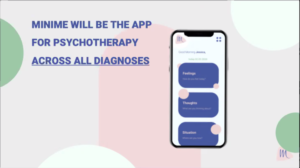
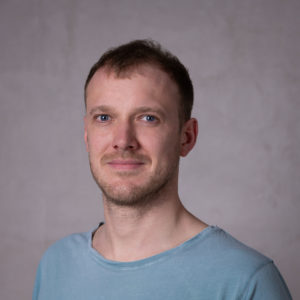
Look no further than minime for a startup that’s helping patients and therapists build a more interactive relationship. Founded by Paul Schneeweiß, a practicing cognitive behavioral therapist, minime was built with psychologists’ needs in mind. The CEO came up with the name for his startup on the train to the hospital where he still works today. “The idea just came to me,” he confessed. “I spoke it out loud and wasn’t really searching for a name, but I thought, Why not? It fits.”
The platform’s name serves as a metaphor for reflecting one’s inner thoughts and feelings— for example through the components that make up the SORC (Situation, Organism, Reaction, Consequence) Model and other self-monitoring strategies in psychology.
What does this model entail? We’ll get to that shortly. For now, we’ll reiterate that the idea behind this innovative mental health startup is for therapists to help patients more efficiently create their own “mini-me.”
A Cutting Edge Approach: Digitizing Paper Logs
Through Schneeweiß’s work in the psychotherapy field, it became clear that there’s a lot of homework involved for both patients and practitioners—generally using paper logs, which have become outdated. “It became obvious we needed to digitize things,” explained minime’s CEO. “To make complex concepts more tangible.”
According to Stella Römhildt, User Experience Director at minime, the worksheets patients complete between sessions is super-complex, and the paper logs aren’t particularly nice to look at. “This is the reality,” she said. “Not just in one setting, but in psychotherapy settings all over Germany.”
So Schneeweiß created a card game—the basis of the startup’s MVP—and integrated it in therapy sessions before developing a digital version. Ask the founder to describe his product, and he’ll cite the many different layers involved.
“On the one hand, we have paper logs,” he described. “And on the other, we have specific self-monitoring strategies.”
In line with the SORC Model, these strategies consist of four layers. These include the client’s: Thoughts, Feelings, Body sensations, Observable behaviour.
By offering a playful take on these four layers—including their triggers and consequences—Schneeweiß and his team have created a digital framework for overcoming challenging behaviours. The platform is essentially a toolbox therapists can use to distribute exercises to patients: creating them, sharing them, and ultimately, analysing them.
Mental Health Treatment Challenges and COVID-19
The COVID-19 pandemic has presented unique opportunities for minime—and a unique set of challenges.
“Therapy changed a lot because [therapists] were so non-digital, and suddenly they had to be [digital],” said Römhildt.
While some therapists continued to work with patients in person—wearing masks to ensure safety—there was an overwhelming disconnect, given the lack of visibility into both parties’ facial expressions. And then, with telehealth appointments, therapists could no longer distribute paper logs. (Unsurprisingly, scanning, printing, and emailing the documents wasn’t an efficient alternative.) While the startup is still in its early stages, minime is offering a solution that transcends digital and in-person therapeutic models. And it comes at an appropriate time—as mental health issues have become more prevalent during the ongoing public health crisis.
“I think with COVID-19 and all these regulations, we were forced to behave unhealthily,” confessed Schneeweiß. “And by unhealthily, I mean reducing your regular contacts, and relying on activating behavior patterns.”
Layoffs, lockdowns, and the financial challenges resulting from the pandemic have only compounded the stress so many of us face—yet we’ve also become more aware. According to Schneeweiß, patients have begun scheduling sessions with the goal of no longer coping in unproductive ways. Some people, for instance, began drinking excessively to deal with the monotony of COVID-19—and many patients want to adopt healthier behavioral patterns instead.
Per the SORC Model, and with minime, they can do just that. The mental health startup has launched at an ideal time, as more and more people begin to advocate for greater transparency.
“The awareness of mental health, and being able to talk more openly about it these past few years, has been a great development,” said Nina Hackenbroich, Full-Stack Developer at minime. “This will always be an issue people face, and society and humanity will improve with this increased visibility.”
The novel coronavirus, and the challenges billions of people around the world have experienced as a result of the pandemic, revealed that everyone has struggles. From this point forward, mental health startups like minime will continue highlighting the benefits of open discussion.
A strong team with a joined mission
The founding team at minime only recently connected on LinkedIn. And while they just added a fourth employee to their roster – the UX/UI & Marketing Expert Rafael R. Da Silva – they have a number of goals toward which they are still working.
Schneeweiß’s objective is simple: “Having therapists who not only like this idea, but who use it and deeply integrate it into their therapy,” he said. “And by ‘deeply,’ I mean, ‘I don’t know how we ever did it using paper logs.’”
Hackenbroich added, “Hopefully we will be in as many therapy practices and hospitals as possible in Germany, and really supporting the patient-therapist relationship.”
As a developer, she’s confident that digital tools like minime will be quite popular in other countries as well. In the next year or so, Römhildt projects a huge number of therapists overcoming their fear of adopting digital tools. “I want minime to really encourage patients to communicate their thoughts and feelings over the week,” she said. “Helping even just some people would be a huge win.”
The mental health startup’s MVP will be ready at the end of August 2021—at which point the team plans to have their first therapist and clients onboarded.
Team minime’s secret weapon for all the progress they’ve made? Römhildt believes they’ve conquered this early stage in large part due to effective communication. “I like to compare it to a romantic relationship,” she said. “Honesty is the most important thing for us. We were honest from the start about our beliefs and struggles. That way we know about everyone’s history and can cut some slack if needed.”
She shared that the founding members regularly check in with one another—asking how things are going—to ensure everyone can speak freely. There are no complex power dynamics, and there’s a sense of openness and integrity that’s integral to the team’s well-being and overall success.
So, what does the path forward look like? Only time will tell—but minime is slated to be a huge hit among therapists looking to securely digitize their paper logs.
“What I’ve learned is that we are used to doing things again and again—to learning patterns,” said Schneeweiß. “If you are doing new things, it comes with a lot of uncertainty that could lead to frustration or a search for short-term solutions. Even building up a company, being aware that uncertainty is okay is key.”
As a therapist and a founder, it’s no wonder that minime’s CEO has mastered the uncertainty so many of us fear. The mental health startup acknowledges that we have to reflect on our anxieties and frustrations, and then accept and release them in order to move forward.
Dr.-Ing. Dr.med.univ. Johannes Starlinger is an experienced digital health and information technology consultant, developer, researcher and interdisciplinary project manager. Having spent significant time in academia with a background in medicine and computer science and a TÜV certification as a specialist for software as a medical device, Johannes is a man of many hats.
He supports companies and young startups in the field of digital health, founded his own company Howto Health – Digital Business Solutions, still teaches occasionally, is a devoted parent and an invaluable mentor to our startup teams here at Vision Health Pioneers Incubator.
What issues or topics are you most motivated to tackle, what Digital Health issues are particularly on your mind at the moment?
“What I find extremely fascinating at the moment is the forthcoming shift from classic, episodic healthcare provided in healthcare facilities towards a more continuous care-for-health with the patient themselves as the point-of-care – whether they happen to be visiting a physician or are enjoying healthcare from the comfort of their home.”
We are currently seeing big tech companies starting to move into this space already and I think it will be very interesting to see how this shift not only transforms the healthcare market, but even more will transform healthcare as we know it.
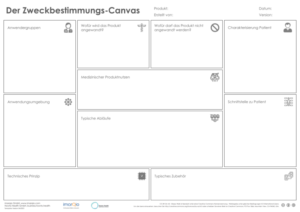
To help young companies in defining their product strategy better, Johannes Starlinger developed a special canvas for healthcare products.
What does success mean to you?
To me, success means being happy with who I am and with what I’m doing today, and with the person I see myself transforming into.
What is the best advice anyone has ever given you?
Don’t take advice from anyone who’s not where you want to be.
How would you describe or characterize your digital health journey?
Well, at the end of my medical studies, I realized how fascinating the possibilities are that digital technologies provide – for applications both within and outside the healthcare system. So I went ahead and studied computer science right after finishing my medical degree. I was lucky to already start exploring the area of biomedical informatics as a working student and continued working as a researcher in this area for over a decade. My focus was on data-powered applications, including, for example, software architecture for distributed processing of biomedical data, the use of genetic data to improve cancer treatment, or the use of data from general practice patient records to predict dementia.
Next to working as a researcher, I’ve been providing IT and digital health consulting and software development services for more than 7 years now and, eventually, found that I enjoy this product-oriented type of work slightly more than the more publication-oriented goals academic research strives for.
“It was an eye-opener for me to do regulatory training and learn about how to actually transform research findings and ideas into medical device products. It still feels like the regulatory know-how was my personal missing puzzle piece to be able to fully interweave my medical and computer science knowledge in the area of digital health.”
So I finally decided to leave academia (for the most part, I still do some teaching) and fully went industry with my own company some 1,5 years ago. The process is still ongoing. I’m very happy with who it’s transforming me into 🙂
What have been your biggest challenges in working through a pandemic, and have you found any silver linings?
As a father of three, managing home kindergarten, homeschooling, and home office all at the same time during the second lockdown was incredibly challenging, not to say nerve-wracking. As with most challenges, there was a great deal of learning to take from it (after getting over the wracked nerves), both on a personal and on a professional level. I hope we don’t have to go through that again, though.
Did you always want to be a leader in digital health? What do you think you might have been if you had taken a different path?
I’m not actually sure I see myself as a leader, I must admit. I’m someone with rather deep knowledge and experience on a rather broad spectrum of all the elements important in digital health: med, tech, and regulatory. And I love to use this knowledge to enable change in the way health and healthcare are delivered and consumed. That being said, I tend to have strong opinions and a certain vision for what healthcare may look like 10 to 20 years from now – and especially how we as individuals make use of the tools given to us to care for our own health much more than we do today, and in a more holistic way.
My alternative path would have been non-health tech. There are so many awesome things digital technology can do in all sorts of areas. And it’s just fun, too 🙂
How would you characterize the digital health space in Berlin/Germany – what are its relative strengths and weaknesses?
I think Berlin (and selected other places in Germany) has a great mix of creative power and all the different skills needed to drive innovation in digital health. This includes a vibrant startup scene, various funding opportunities, a plethora of biotech industry and startup-friendly universities. At the same time, I think the interlink between digital health innovation driven from outside the healthcare system, e.g., by innovative startups, on the one hand, and participants within the healthcare system on the other hand, could be much better. Currently, it’s often very difficult for startups to engage with partners within healthcare.
What do you do to unwind?
Cycling relaxes me almost instantly. Decent booze with the right company does the trick in the right circumstances.
“Going for a walk, possibly with some good music, does many good things.”
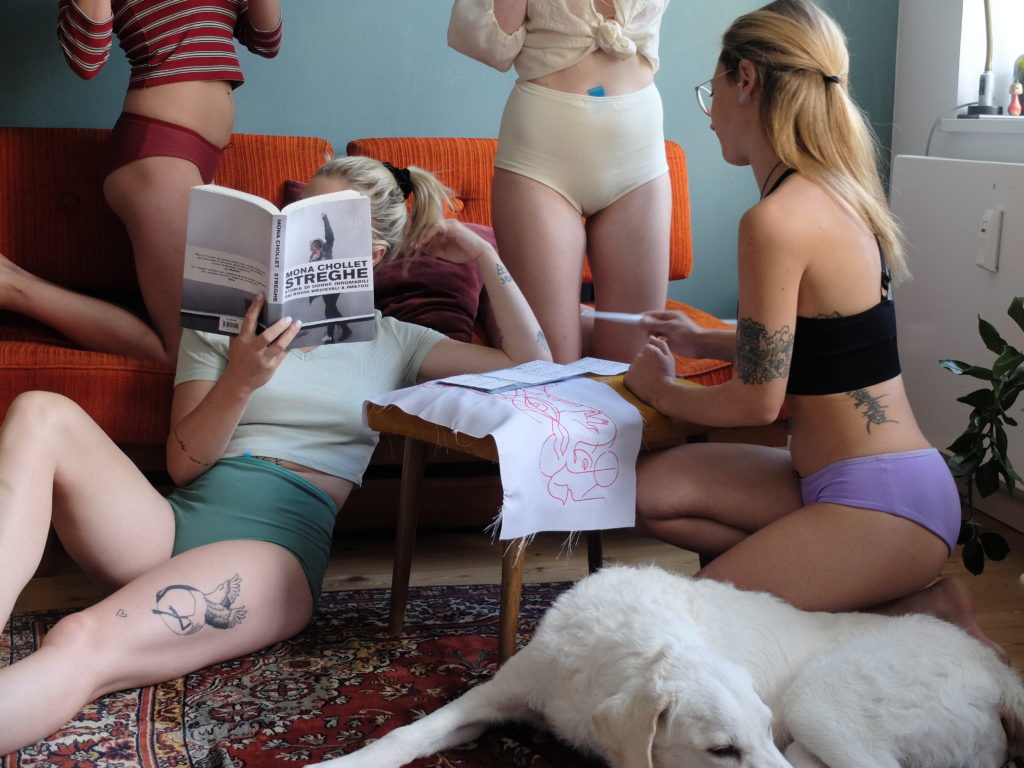
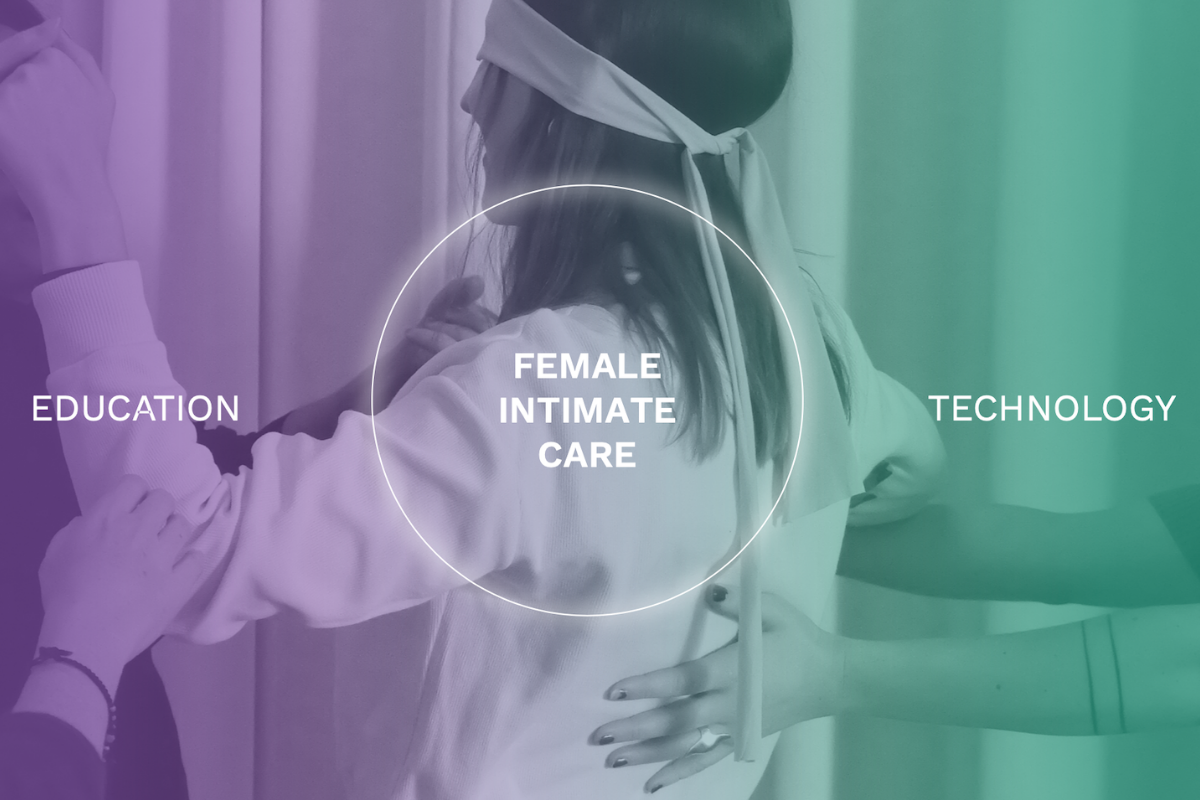
Born in 2018, ALMA fuses design, anthropology and technology in their bid to create a cultural revolution in the area of female intimate care. ALMA is a collaborative practice that connects professionals from all around Europe. Their team comprises of Giulia and Isabel who utilise design and anthropological methods in creating solutions, Tommaso and Ryo who are scientists materialising ideas into products, Tauras a graphic designer, Anjali a data scientist, Alice their design intern and their to be onboarded software developer.
Here in Berlin, they are represented by founder Giulia and Tauras, who have been busy developing a wearable biosensor that monitors the pH in vaginal fluids, setting up a global community platform and completing a book about female intimate care innovation.
ALMA Universe: Creating Cultural Change in Female Intimate CareThrough Education and Technology
Lovingly known as “ALMA Universe”, ALMA’s work sits at the praxis of science, technology and culture. It draws inspiration from the very community it seeks to empower, and to date, they have run numerous workshops exploring the hearts and minds of more than 400 participants across the world.
Their website showcases the extensive work they have done surrounding female intimate health, with aesthetics that echo a Sofia Coppola film. For ALMA, design and aesthetics are political.
“The depiction of female intimate care in society is typically very medical. We want to show the normality that comes with it and with that, of course, the beauty that goes together with it – because it should attract and be something that inspires people to want to engage and know more.”
In designing a wearable sensor, it is not simply designing something beautiful and feminine. Rather, there is a need to ensure a level of comfort for their users. Not just in wearability, but in how it presents on the person. They question everything, including the traditional notions of femininity, its’ aesthetics and the role it plays in the stigma and politics that surround the issue of female intimate care.
“The stigma and silencing behind female intimate care come from a problem within the system, within culture. Our solution in addressing this is to bring awareness through technology and education. To gain profit from spreading awareness sounds like a joke to us. In an industry that is primarily still profit-driven, we are like white flies.”
Throughout their time at the incubator, ALMA has struggled to articulate their complex vision within the strictly enforced 4 minute timed pitch sessions. This is in part due to their unconventional approach to innovation. Essentially their mission is not just the development of a wearable sensor, the technology or the innovation. Rather, ALMA is already looking three steps ahead towards the cultural change their work will bring as their end product.
White Flies of the Femtech World
In Italy, the white fly is the one that stands out as different from all the others. That’s ALMA, who are developing an entirely not-for-profit, non-medical, community platform based on user experience. Inspired by their workshop series ALMA meets Flora, they are aiming to build an inclusive, crowd-sourced community platform around female intimate health.
ALMA sees the value and wisdom of the female body and the sum of their experiences. Building this platform is the first step towards fostering a movement of awareness– a movement that seeks to see individuals empowered and in control of their health through a holistic approach. This platform would serve also to allow open dialogue to take place in a safe space. Dialogue is of great importance, considering the culture of silence that blankets this field. Giving a voice to their target demographic allows for the normalisation of female health issues and the breaking of stigmas and taboos. It also allows for the advocacy of female intimate health that is still regretfully, greatly underrepresented in modern medicine.
“There are so many areas that still fall short in modern medicine when it comes to female bodies. It is such a shame that we are flying to Mars, but still so much is to be known about what’s happening in the female body.”
Language, Community and Co-Creating Knowledge
Throughout their time at the incubator, ALMA have been able to better align with their core values. They are seeking impact investors, perhaps even partnerships where there can be a co-creation of knowledge. Their book, which acts as an introduction to their platform, will be completed in September.
ALMA’s methodology is based on user diaries that describe their current experiences searching for information regarding intimate health. This has comprised of a survey where users’ preferences in terms of features were explored and participatory workshops in different cultural contexts. Data of which has been used to design the platform.
When asked what gets them up in the morning, Giulia speaks about her constant inspiration to bring about this change. For Tauras, it is the realisation that the clock is ticking and there is still much to be done.
Participants who are interested can now access the survey they have recently launched. Here, ALMA invites participants to take on an active role in co-designing the Atlas.
Mentor Oliver Eidel is a medical doctor, self-taught programmer, and founder of OpenRegulatory, helping startups become compliant since 2020. At Vara, he was an integral part of the team that developed Germany’s first AI software for breast cancer screening and got it certified as a medical device. Self-taught as well, in regulatory compliance, Oliver went on to found OpenRegulatory to make regulation more transparent through free templates and a Slack community.
When he is not solving regulatory compliance problems, he uses his free time to fly airplanes and enjoys a good shut-eye. Keep up with Oliver and his work via his blogand at OpenRegulatory.
What do you think are the best steps to enter the digital health space?
First off: I have a huge amount of respect for anyone attempting to enter the Digital Health Market and trying to build a company around it. It’s full of incumbents, slow-moving customers and, on top of that, heavily regulated. You need an almost pathological dose of optimism (or ignorance) if you want to persist in trying to enter it.
That being said, I think it’s the most exciting and fulfilling field to be in! What’s more exciting than improving Healthcare, essentially improving people’s lives? Sending people to Mars, maybe. But then again, those people on Mars also need Healthcare. And they’ll need digital health, because right now, we don’t have fax machines on Mars!
So – how to enter it? It’s tricky and there’s no perfect way.
Explore some of the free tutorials from Oliver Eidel
There are two paths you can take: The first one is Healthcare-heavy. You work “within the system”, as a physician, nurse, technician, etc. – that directly exposed you to all the day-to-day problems which need solving. You can easily come up with product ideas. But now you’re facing a problem: How do you build a product “within the system”, who will work with you and who’s going to buy it? Chances are, the hospital you’re working in and the people surrounding you aren’t that interested in founding a startup and building something risky and innovative. So you need to take the second path, which is startup-heavy. You join a Healthcare startup which connects you with like-minded people, funding, and the opportunity to build something. But now, you’ve moved further away from the actual problem which you experienced in your day-to-day work at the hospital!
As you can see, there’s no perfect way. The perfect way would be to work in an innovative hospital (or doctor’s practice) while being able to build something new.
That sort of setup doesn’t exist as of today. The next best alternative is to work in a startup. But again, today’s startups have a high risk of developing the wrong thing because they’re not close enough to the actual problem.
What digital health issues are particularly on your mind at the moment?
Building a Hospital Information Software which doesn’t suck. I think there would be so much awesome leverage there! You should see the software they use nowadays in hospitals, it’s unbelievable. I’ve seen students being employed to copy-paste things inside crappy software all day long because there weren’t interfaces to export data, for example for research purposes.
Think of all the time physicians, nurses and assistants spend on wrestling with slow software and confusing user interfaces, imagine all the time we could free up!
Everyone’s talking about the impending lack of personnel in hospitals, but hardly anyone is talking about how much time crappy software currently consumes. Sure, we might not solve the entire personnel problem with software, but we might get closer.
Well, that’s the problem I’d like to solve if I had infinite resources. For the time being, I’m trying to solve the problem of regulatory compliance for Healthcare startups at OpenRegulatory. It’s interesting: Every startup has this huge pain dealing with regulatory compliance and there’s hardly any free information available online. I’m trying to change that.
How would you characterise the digital health space in Berlin/Germany?
Firstly, you’ve got all the relevant ingredients for building great Healthcare startups: A fairly large ecosystem of startups with smart people, funding, and even a connection to politics via the Health Innovation Hub. For someone coming from Heidelberg like me, the fact that there are more than three startups to choose from is very exciting!
Also, the German Healthcare system which treats everyone, and treats everyone equally (more or less), while being fairly efficient (efficient being defined as “not a complete catastrophe like in the US”). Then, you have the recent political changes which made apps reimbursable by insurances (“DiGAs”). I’m not entirely sure how that will pan out, but it’s an exciting move in the right direction and will boost innovation and the Healthcare startup ecosystem for sure. There’s a lot of startup optimism here – that’s great! But sometimes, it’s maybe a little too much, and maybe a little too tech-centered. Seemingly every startup wants to apply machine learning to Healthcare – but why?
I think many founders have never been inside a hospital. You don’t need machine learning to replace fax machines. Every day, physicians and nurses are fighting with crappy software. The next logical improvement to crappy software is not machine learning – it’s non-crappy software.
Many startups don’t understand that, and I’m not sure why. There are many possible reasons: “Only” building non-crappy software doesn’t sound very sexy, especially to VCs. Also, non-crappy software is often connected to solving big problems, and solving big problems is very risky, like building a Hospital Information System which doesn’t suck – I imagine it being near-impossible to sell this sort of software to hospitals as a startup.
So, that leads to startups building isolated solutions (often apps) for isolated problems, with some machine learning mixed in. It’s less risky, and it’s more sexy. But it leads to a lot of duplicated effort: Right now, every startup is effectively reimplementing their own Electronic Health Record inside their software. Every software has its own, distinct user interface, also for physicians. And if there’s one thing which physicians hate, then it’s using yet another new software with its new user interface!
Anyway, right now, we have lots of innovative stuff being built, but it’s all isolated from each other. I don’t think that this will be sustainable – neither patients nor physicians want to interact with multiple applications regularly. Then again, I’m happy about the innovation happening and this might just be the first wave of startups we’re seeing in this space, and maybe, hopefully, we’ll have more integrated solutions in the future.
I’m not sure if the classical VC-funded-startup model maps well to Healthcare startups. It’s all about growing fast, capturing a market and then selling the company. But even only that first step, growing fast, is often impossible: Sales cycles are long and integration efforts are complex.
Sometimes I wonder whether the old-school business model of growing a small, profitable business maps better to Healthcare as it forces you to consistently deliver value to your customers. I’m a big fan of that. Not sure though if they even teach that at business schools nowadays.”
How do you picture the digital health space in Germany looking in five years?
I’m very bad at predicting the future. Here’s what I would hope:
We continue to sustain the momentum of Healthcare innovation which we’re seeing right now, while startups have figured out how to implement sustainable business models in digital health, maybe through reimbursable apps (DiGAs), maybe through some other way. Other startups are finally getting started on solving the big problems like building better Hospital Information Systems.
And, on a more personal level: I hope I’ll need less than five phone calls to book an appointment with a specialist. I hope I no longer have to organise and scan my own paper-based medical records.
Physicians actually prepare and read my medical file before I walk through the door. And, finally, software will actually reduce the time which physicians spend on tedious tasks so that they can spend more time with patients. That’s still the holy grail, and right now, we’re not doing a great job at achieving it.
What advice would you give your younger self?
I think that my generation (I’m 30 now) faces an interesting situation: We have way too many job options. It’s hard to decide and you’re likely to be unsatisfied with whatever you chose. I could have worked as a physician, researcher, or software engineer – the latter not even limited to Healthcare. There’s a near-infinite amount of job opportunities for those combinations! I acknowledge this as a first-world problem, but still: It’s a problem I’ve seen many people struggle with.
So here’s the advice I’d give my younger self: “Sometimes, procrastinating a decision is worse than making a crappy one. Just make your decision.
It took me one year of hanging around my parents and some lucky coincidences to move to Berlin and join my first startup. Even if decisions are crappy, nowadays you can revert most of them or at least mitigate their impact with different decisions in the future.
In honor of Pride month, Vision Health Pioneers Incubator is taking the opportunity to give prominence to issues in the healthcare industry experienced by our friends in the LGBTQ+ community.
The Call For Inclusive Healthcare
Despite the many advances in healthcare today, access, representation and inclusivity in healthcare remain an issue of contention for the LGBTQ+ community. They continue to face significant challenges when accessing healthcare while also suffering a greater burden of particular health issues: depression, isolation, suicide, HIV/STIs and cancer.
The healthcare industry strives to inspire hope and to their best of their ability provide patient-centered healthcare. However, LGBTQ+ and minority patients continue to report experiences tainted by stigma, hate-violence and discrimination. Surveys have reported experiences that range from refusal to be seen, addressed with harsh or abusive language and misgendering amongst a disturbing list of other harassments and humiliations when seeking care.
This has unsurprisingly discouraged LGBTQ+ people from accessing healthcare. While LGBTQ+ community health centres and services do exist, they are not as widely available or easily accessed. There remains as well, a distinct lack of knowledge amongst healthcare providers on the correct anatomical language to create a safe space for all. As providers struggle to describe bodies and patients outside of gendered terms, this gap in communication has left a demographic of people feeling entirely unseen and unheard.
These barriers in accessing healthcare is a trauma in itself. Inadvertently, it contributes to the vulnerabilities and health risks of LGBTQ+ people who opt out of seeking medical attention for fear of being othered.
A majority proportion of national health surveys that do not collect information on sexual orientation and gender identity poses as a furthered form of discrimination. Again, while there have been improvements and greater attention in recent years, there remains a distinct health data gap for LGBTQ+ people, with their specific health risks being left out entirely in what informs public healthcare.
Undoubtably there is a need for enhanced awareness amongst healthcare providers and greater community consciousness. In looking towards health innovations that could help fill the gap in healthcare for this community, digital health tools are emerging as essential.
Digital Health Tools and LGBTQ+ Health
In an era where digital communication is preferred, mental health innovations that allow for support via text and calls are providing a much needed space for people to reach out digitally in a moment of crisis. The increased anonymity through digital applications as well, allows for a wider spread and hopefully more inclusive demographic that will seek out support. Meet a few organisations that inspire:
Online platforms allow individuals to access culturally competent healthcare and come together in a digital safe space. For instance, sites such as Violet and EmptyClosets that allow members of the community to connect.
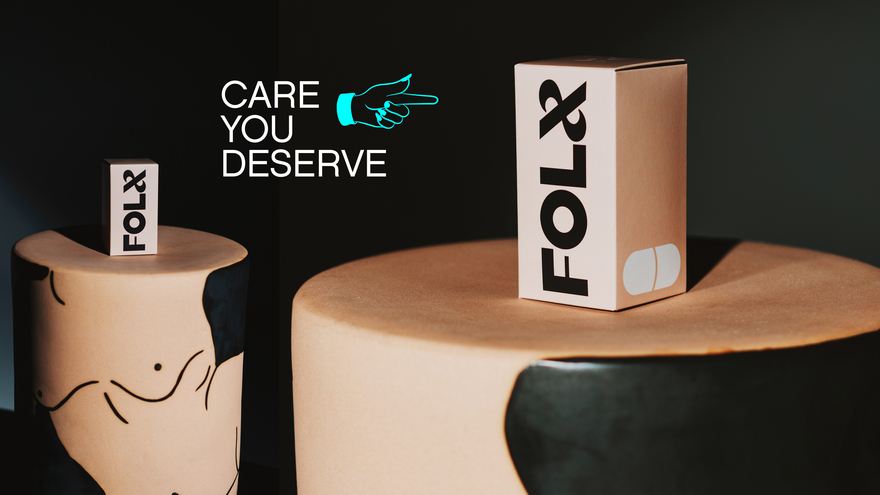
Also read more here on Foxl Health, the direct-to-consumer health startup designed with LGBTQ+ patients in mind and how other digital health startups are driving the change towards more inclusive healthcare.
Closer to home within our incubator, our Batch #2 team minime have been working on a self-monitoring Cognitive Behavioural Therapy tool. It serves to introduce greater flexibility and ease of access in therapy and allows patients to self-monitor between sessions in a fun way.
Our Batch #2 team ALMA recognise the value of connection, education and dialogue. They are working on creating a community platform to tackle the stigmatised and often silenced issue of female intimate healthcare
A long road is still ahead
This shift towards digital health tools prioritising health education in an open, culturally relevant environment is an encouraging step towards greater inclusion in healthcare. While much work remains to be done, there is hope that the future holds improved healthcare prospects for the LGBTQ+ community.
To all the founders out there: KEEP THE NEEDS OF THE LGBTQ+ COMMUNITY IN MIND AND CREATE INCLUSIVE SOLUTIONS THAT EMBRACE ALL PATIENTS NEEDS.
Are you still in hibernation? Wake up! May is National Walking month and we, here at #VisionHealthPioneers Incubator are embarking on a Walking Challenge to cover a whopping 999kms!
Why 999km you might wonder? It is exactly the distance from Berlin to the UN Refugee Agency headquarters in Geneva, Switzerland. Because we are not “just walking”. Aside from taking the opportunity to enjoy Berlin at its most beautiful in spring, this May, we will be raising money towards the UN Refugee Agency’s COVID-19 Urgent Appeal Fund. For every 1km of this 999km, Vision Health Pioneers Incubator will match a 1 Euro donation totalling 999 Euro.
Our Cause
We chose the UN Refugee Agency in recognition of the devastating impact COVID-19 has had on the world’s most vulnerable people. As the pandemic continues, COVID-19 has proven itself to be the greatest exposure of existing inequalities. While social distancing and hand washing may seem to a lot of us easy practices to follow, it is a privilege we take for granted. It assumes access to sanitation, running water and living spaces large enough to practice it.
Large proportions of the world’s refugee population live in cramped and impoverished camps or settlements, somewhere between their home countries and hopes of a better life. Even here in Germany their living conditions as they apply for asylum are crowded and rife with challenges.
The vulnerabilities that migrants and refugees experience run deep and have been in existence long before COVID-19.
It is with hopes that this global pandemic will in spite of all the suffering, bring to fore these structural inadequacies so that more people will be aware of the need to support these populations. The health of every person is linked to the health of the most marginalised and vulnerable members in a society.
Join us to not only raise money but also awareness for the healthcare and realisation of refugee human rights.
The teams
All our Batch #2 startups are battling, the incubator team have also dusted off their walking shoes and are participating as The Hot Steppers.
Johannes Steger is principal consultant and the current head honcho of communications at Plan D, a young technology and strategy consultancy actively shaping the face and experience of digitisation in the modern world, Plan D is Vision Health Pioneers’ most recent partner to come on board.
At ease in their spacious, industrial loft-style offices, Johannes is candid about the incredible journey of his career that has taken him from the buzzing tech startup scene of Tel Aviv as a journalist, to where he is today in Berlin. Despite having worked for many years as a tech journalist, Johannes humbly admits that his present role working with coding, engineers and data scientists has made him realise he knows nothing. That for him is an exciting revelation that he embraces as an opportunity to push himself out of his comfort zone. With this effortless capacity to step up to a challenge and an enthusiasm for all things tech, Johannes is a long-time champion of the startup community.
For him, startup culture poses as a powerful interrupter and driver of industry diversity.
The capacity of startup culture to birth forward-thinking founders and level the playing field through greater gender representation, is one that that he believes, “ultimately drives a country and the whole of Europe.”
On Mentorship and Giving Back
“I think everyone who works in this ecosystem has the obligation to do something good. We all profit from this great Berlin ecosystem but living this startup life and being in this ecosystem comes with the obligation of giving something back.”
As a mentor at Vision Health Pioneers, Johannes has facilitated workshops on vision, stakeholders and messaging. He has also contributed his time and presence facilitating the recent Batch #2 pitch event. For Johannes, his involvement with Vision Health Pioneers is not just an extension of his love for technology and his belief in the integral role technology and data has and will come to play in the health industry. Rather, as a participant of the Berlin startup ecosystem, it is his commitment to building up and enabling others to drive the ecosystem further. As a natural visionary, there is a bigger picture and greater good that he is working towards in his guidance and mentorship of new startups.
“Vision Health Pioneers incubator is not only diverse by way of culture, but also the various solutions the startups bring to health. It is amazing that there is an incubator giving power and room for ideas that are finally bringing attention to stigmatised topics such as mental health and female intimate health”.
On Visibility, Being Present and Stakeholder Management
When it comes to networking, visibility and messaging, Johannes does not sugar coat the importance it plays for early startups. However, his core take-home message is simple: concern yourself with the needs of others, not just yourself. “Visibility can also mean being in an audience and listening. Being present, listening, learning and not necessarily always engaging. Just be there and learn. It is not always about talking and present by way of ‘presenting’ yourself but ‘present and listening’. This for me is essential for networking and visibility”.
On Purpose, Messaging and Owning Your Story
There is a commitment to truth and integrity that Johannes stresses must be upheld from purpose through to the messages that are conveyed, particularly within the healthcare industry. Here, he is quick to draw the distinction between up-selling pizza and healthcare solutions. While there is an end-user in both instances, when it comes to health, it is important to bear in mind that a life is dependent on it.
“In communicating something about your product, you have to be very sure what you say and promise. Don’t promise anything you cannot keep, because even if the consequences of embellishment or false promise are not deadly, it is a pain that a person at the other end is feeling, be it a mental pain or a physical one”.
With regards to purpose, it is important for healthcare startups to not be solely profit-driven, but to be clear on what drives the innovation.
“With Vision Health Pioneers Incubator, every founder seems to have a personal relationship to the product they are building. When guiding the teams, I often tell them to use their personal story in their communications. It does not only have to be ‘I am suffering’, but it could also be, ‘I saw someone else’s suffering.”
At the recent Pitch event, his guidance was evidenced in the stories put forth by the young startups. Beyond open and honest, this authentic voice that Johannes encourages in communication is a bold declaration that gives a voice to invisible and stigmatised issues in healthcare. Putting these stories out there not only fosters connection. It holds the immense power to create dialogue, give hope and forge role models and leaders out of an idea born from one person’s story.
 “We accumulated our expertise in a customizable white label solution that brings together people, knowledge, products, services, and data. Next step is introducing the “Ecosystems connect” module that will allow co-integrating operating ecosystems and building an interoperable network of globally connected innovation ecosystems.”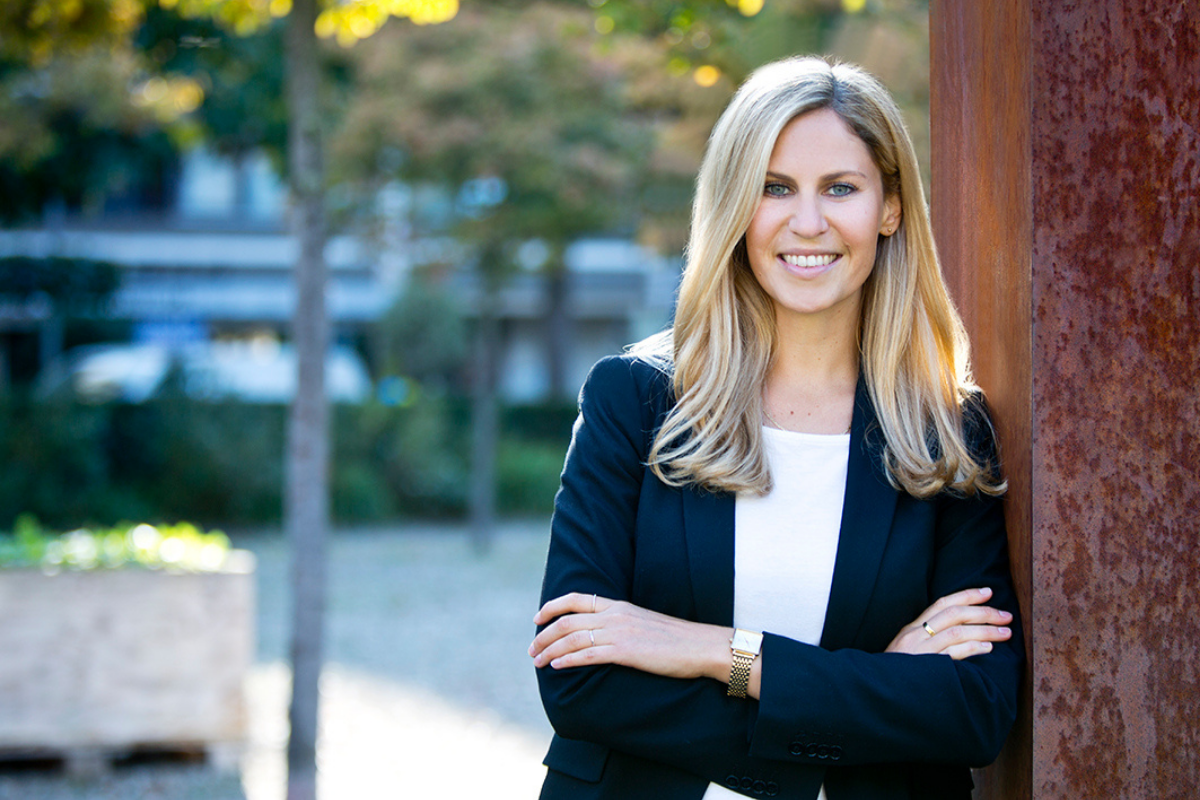


 Through Schneeweiß’s work in the psychotherapy field, it became clear that there’s a lot of homework involved for both patients and practitioners—generally using paper logs, which have become outdated. “It became obvious we needed to digitize things,” explained minime’s CEO. “To make complex concepts more tangible.”
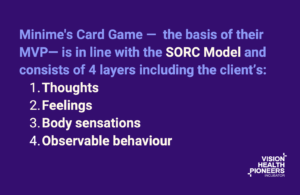 “On the one hand, we have paper logs,” he described. “And on the other, we have specific self-monitoring strategies.”
  While some therapists continued to work with patients in person—wearing masks to ensure safety—there was an overwhelming disconnect, given the lack of visibility into both parties’ facial expressions. And then, with telehealth appointments, therapists could no longer distribute paper logs. (Unsurprisingly, scanning, printing, and emailing the documents wasn’t an efficient alternative.) While the startup is still in its early stages, minime is offering a solution that transcends digital and in-person therapeutic models. And it comes at an appropriate time—as mental health issues have become more prevalent during the ongoing public health crisis.
 “The awareness of mental health, and being able to talk more openly about it these past few years, has been a great development,” said
  The founding team at minime only recently connected on LinkedIn. And while they just added a fourth employee to their roster – the UX/UI & Marketing Expert
  The mental health startup’s MVP will be ready at the end of August 2021—at which point the team plans to have their first therapist and clients onboarded.

 Born in 2018, ALMA fuses design, anthropology and technology in their bid to create a cultural revolution in the area of female intimate care. ALMA is a collaborative practice that connects professionals from all around Europe. Their team comprises of