Categories
Our Mentors Training & Coaching

A Spotlight on Our Mentor Johannes Starlinger

Dr.-Ing. Dr.med.univ. Johannes Starlinger is an experienced digital health and information technology consultant, developer, researcher and interdisciplinary project manager. Having spent significant time in academia with a background in medicine and computer science and a TÜV certification as a specialist for software as a medical device, Johannes is a man of many hats.

He supports companies and young startups in the field of digital health, founded his own company Howto Health – Digital Business Solutions, still teaches occasionally, is a devoted parent and an invaluable mentor to our startup teams here at Vision Health Pioneers Incubator. 

What issues or topics are you most motivated to tackle, what Digital Health issues are particularly on your mind at the moment?


“What I find extremely fascinating at the moment is the forthcoming shift from classic, episodic healthcare provided in healthcare facilities towards a more continuous care-for-health with the patient themselves as the point-of-care – whether they happen to be visiting a physician or are enjoying healthcare from the comfort of their home.”


We are currently seeing big tech companies starting to move into this space already and I think it will be very interesting to see how this shift not only transforms the healthcare market, but even more will transform healthcare as we know it.
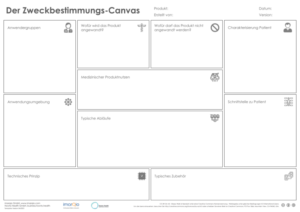
 

The Purpose Canvas / der Zweckbestimmungs-Canvas
To help young companies in defining their product strategy better, Johannes Starlinger developed a special canvas for healthcare products.

What does success mean to you?

To me, success means being happy with who I am and with what I’m doing today, and with the person I see myself transforming into.


What is the best advice anyone has ever given you?

Don’t take advice from anyone who’s not where you want to be.


How would you describe or characterize your digital health journey?

Well, at the end of my medical studies, I realized how fascinating the possibilities are that digital technologies provide – for applications both within and outside the healthcare system. So I went ahead and studied computer science right after finishing my medical degree. I was lucky to already start exploring the area of biomedical informatics as a working student and continued working as a researcher in this area for over a decade. My focus was on data-powered applications, including, for example, software architecture for distributed processing of biomedical data, the use of genetic data to improve cancer treatment, or the use of data from general practice patient records to predict dementia.

Next to working as a researcher, I’ve been providing IT and digital health consulting and software development services for more than 7 years now and, eventually, found that I enjoy this product-oriented type of work slightly more than the more publication-oriented goals academic research strives for.

“It was an eye-opener for me to do regulatory training and learn about how to actually transform research findings and ideas into medical device products. It still feels like the regulatory know-how was my personal missing puzzle piece to be able to fully interweave my medical and computer science knowledge in the area of digital health.”


So I finally decided to leave academia (for the most part, I still do some teaching) and fully went industry with my own company some 1,5 years ago. The process is still ongoing. I’m very happy with who it’s transforming me into 🙂


What have been your biggest challenges in working through a pandemic, and have you found any silver linings?

As a father of three, managing home kindergarten, homeschooling, and home office all at the same time during the second lockdown was incredibly challenging, not to say nerve-wracking. As with most challenges, there was a great deal of learning to take from it (after getting over the wracked nerves), both on a personal and on a professional level. I hope we don’t have to go through that again, though.


Did you always want to be a leader in digital health? What do you think you might have been if you had taken a different path?

I’m not actually sure I see myself as a leader, I must admit. I’m someone with rather deep knowledge and experience on a rather broad spectrum of all the elements important in digital health: med, tech, and regulatory. And I love to use this knowledge to enable change in the way health and healthcare are delivered and consumed. That being said, I tend to have strong opinions and a certain vision for what healthcare may look like 10 to 20 years from now – and especially how we as individuals make use of the tools given to us to care for our own health much more than we do today, and in a more holistic way.

My alternative path would have been non-health tech. There are so many awesome things digital technology can do in all sorts of areas. And it’s just fun, too 🙂


How would you characterize the digital health space in Berlin/Germany – what are its relative strengths and weaknesses?

I think Berlin (and selected other places in Germany) has a great mix of creative power and all the different skills needed to drive innovation in digital health. This includes a vibrant startup scene, various funding opportunities, a plethora of biotech industry and startup-friendly universities. At the same time, I think the interlink between digital health innovation driven from outside the healthcare system, e.g., by innovative startups, on the one hand, and participants within the healthcare system on the other hand, could be much better. Currently, it’s often very difficult for startups to engage with partners within healthcare.


What do you do to unwind?

Cycling relaxes me almost instantly. Decent booze with the right company does the trick in the right circumstances.


“Going for a walk, possibly with some good music, does many good things.”

Categories
Our Mentors Training & Coaching

Mentor Oliver Eidel And His Thoughts On The Digital Health Space In Germany

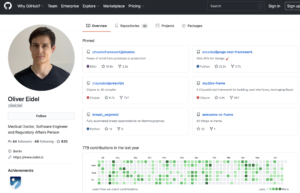
Mentor Oliver Eidel is a medical doctor, self-taught programmer, and founder of OpenRegulatory, helping startups become compliant since 2020. At Vara, he was an integral part of the team that developed Germany’s first AI software for breast cancer screening and got it certified as a medical device. Self-taught as well, in regulatory compliance, Oliver went on to found OpenRegulatory to make regulation more transparent through free templates and a Slack community.

When he is not solving regulatory compliance problems, he uses his free time to fly airplanes and enjoys a good shut-eye. Keep up with Oliver and his work via his blog and at OpenRegulatory.


What do you think are the best steps to enter the digital health space?

First off: I have a huge amount of respect for anyone attempting to enter the Digital Health Market and trying to build a company around it. It’s full of incumbents, slow-moving customers and, on top of that, heavily regulated. You need an almost pathological dose of optimism (or ignorance) if you want to persist in trying to enter it.

That being said, I think it’s the most exciting and fulfilling field to be in! What’s more exciting than improving Healthcare, essentially improving people’s lives? Sending people to Mars, maybe. But then again, those people on Mars also need Healthcare. And they’ll need digital health, because right now, we don’t have fax machines on Mars!

So – how to enter it? It’s tricky and there’s no perfect way.

Explore some of the free tutorials from Oliver Eidel


There are two paths you can take: The first one is Healthcare-heavy. You work “within the system”, as a physician, nurse, technician, etc. – that directly exposed you to all the day-to-day problems which need solving. You can easily come up with product ideas. But now you’re facing a problem: How do you build a product “within the system”, who will work with you and who’s going to buy it? Chances are, the hospital you’re working in and the people surrounding you aren’t that interested in founding a startup and building something risky and innovative. So you need to take the second path, which is startup-heavy. You join a Healthcare startup which connects you with like-minded people, funding, and the opportunity to build something. But now, you’ve moved further away from the actual problem which you experienced in your day-to-day work at the hospital!

As you can see, there’s no perfect way. The perfect way would be to work in an innovative hospital (or doctor’s practice) while being able to build something new.


That sort of setup doesn’t exist as of today. The next best alternative is to work in a startup. But again, today’s startups have a high risk of developing the wrong thing because they’re not close enough to the actual problem.


What digital health issues are particularly on your mind at the moment?

Building a Hospital Information Software which doesn’t suck. I think there would be so much awesome leverage there! You should see the software they use nowadays in hospitals, it’s unbelievable. I’ve seen students being employed to copy-paste things inside crappy software all day long  because there weren’t interfaces to export data, for example for research purposes.

Think of all the time physicians, nurses and assistants spend on wrestling with slow software and confusing user interfaces, imagine all the time we could free up!


Everyone’s talking about the impending lack of personnel in hospitals, but hardly anyone is talking about how much time crappy software currently consumes. Sure, we might not solve the entire personnel problem with software, but we might get closer.

Well, that’s the problem I’d like to solve if I had infinite resources. For the time being, I’m trying to solve the problem of regulatory compliance for Healthcare startups at OpenRegulatory. It’s interesting: Every startup has this huge pain dealing with regulatory compliance and there’s hardly any free information available online. I’m trying to change that.


How would you characterise the digital health space in Berlin/Germany?

Firstly, you’ve got all the relevant ingredients for building great Healthcare startups: A fairly large ecosystem of startups with smart people, funding, and even a connection to politics via the Health Innovation Hub. For someone coming from Heidelberg like me, the fact that there are more than three startups to choose from is very exciting!

Also, the German Healthcare system which treats everyone, and treats everyone equally (more or less), while being fairly efficient (efficient being defined as “not a complete catastrophe like in the US”). Then, you have the recent political changes which made apps reimbursable by insurances (“DiGAs”). I’m not entirely sure how that will pan out, but it’s an exciting move in the right direction and will boost innovation and the Healthcare startup ecosystem for sure.
There’s a lot of startup optimism here – that’s great! But sometimes, it’s maybe a little too much, and maybe a little too tech-centered. Seemingly every startup wants to apply machine learning to Healthcare – but why?

I think many founders have never been inside a hospital. You don’t need machine learning to replace fax machines. Every day, physicians and nurses are fighting with crappy software. The next logical improvement to crappy software is not machine learning – it’s non-crappy software.


Many startups don’t understand that, and I’m not sure why. There are many possible reasons: “Only” building non-crappy software doesn’t sound very sexy, especially to VCs. Also, non-crappy software is often connected to solving big problems, and solving big problems is very risky, like building a Hospital Information System which doesn’t suck – I imagine it being near-impossible to sell this sort of software to hospitals as a startup.

So, that leads to startups building isolated solutions (often apps) for isolated problems, with some machine learning mixed in. It’s less risky, and it’s more sexy. But it leads to a lot of duplicated effort: Right now, every startup is effectively reimplementing their own Electronic Health Record inside their software. Every software has its own, distinct user interface, also for physicians. And if there’s one thing which physicians hate, then it’s using yet another new software with its new user interface!

Anyway, right now, we have lots of innovative stuff being built, but it’s all isolated from each other. I don’t think that this will be sustainable – neither patients nor physicians want to interact with multiple applications regularly. Then again, I’m happy about the innovation happening and this might just be the first wave of startups we’re seeing in this space, and maybe, hopefully, we’ll have more integrated solutions in the future.

I’m not sure if the classical VC-funded-startup model maps well to Healthcare startups. It’s all about growing fast, capturing a market and then selling the company. But even only that first step, growing fast, is often impossible: Sales cycles are long and integration efforts are complex.


Sometimes I wonder whether the old-school business model of growing a small, profitable business maps better to Healthcare as it forces you to consistently deliver value to your customers. I’m a big fan of that. Not sure though if they even teach that at business schools nowadays.”


How do you picture the digital health space in Germany looking in five years?

I’m very bad at predicting the future. Here’s what I would hope:

We continue to sustain the momentum of Healthcare innovation which we’re seeing right now, while startups have figured out how to implement sustainable business models in digital health, maybe through reimbursable apps (DiGAs), maybe through some other way. Other startups are finally getting started on solving the big problems like building better Hospital Information Systems.

And, on a more personal level: I hope I’ll need less than five phone calls to book an appointment with a specialist. I hope I no longer have to organise and scan my own paper-based medical records.


Physicians actually prepare and read my medical file before I walk through the door. And, finally, software will actually reduce the time which physicians spend on tedious tasks so that they can spend more time with patients. That’s still the holy grail, and right now, we’re not doing a great job at achieving it.


What advice would you give your younger self?

I think that my generation (I’m 30 now) faces an interesting situation: We have way too many job options. It’s hard to decide and you’re likely to be unsatisfied with whatever you chose. I could have worked as a physician, researcher, or software engineer – the latter not even limited to Healthcare. There’s a near-infinite amount of job opportunities for those combinations! I acknowledge this as a first-world problem, but still: It’s a problem I’ve seen many people struggle with.

So here’s the advice I’d give my younger self: “Sometimes, procrastinating a decision is worse than making a crappy one. Just make your decision.


It took me one year of hanging around my parents and some lucky coincidences to move to Berlin and join my first startup. Even if decisions are crappy, nowadays you can revert most of them or at least mitigate their impact with different decisions in the future.


What is the best advice anyone ever gave you?

“Cut your losses” (my mom).

Categories
Training & Coaching

Bulletproof startups:
How to build solid teams in challenging times

When our incubator first opened its doors almost two years ago and welcomed our first batch of bright-eyed and bushy-tailed digital health entrepreneurs—little did we know how current events would look and what a challenging set of circumstances would unfold.

Needless to say, working through a pandemic has brought a host of unexpected obstacles, alongside several valuable learning experiences. As we welcomed our second batch at the height of the second wave here in Berlin, we took some time to reflect on these experiences and especially what they told us about how to help build and nurture winning startups through such trying and unsure times that have also—by way of silver linings—brought about a digital healthcare boom.

Communication is key

If there is one thing we have learnt through our first year in existence—which some might describe as a bit of a baptism of fire—is that what makes or breaks a startup more than anything is how well the individuals work together; the interpersonal alchemy that separates teams that prevail from those that do not. We learnt that it is essential that members share a common mission and that the way that they interact and their roles are defined and structured ensures a healthy and productive team culture.

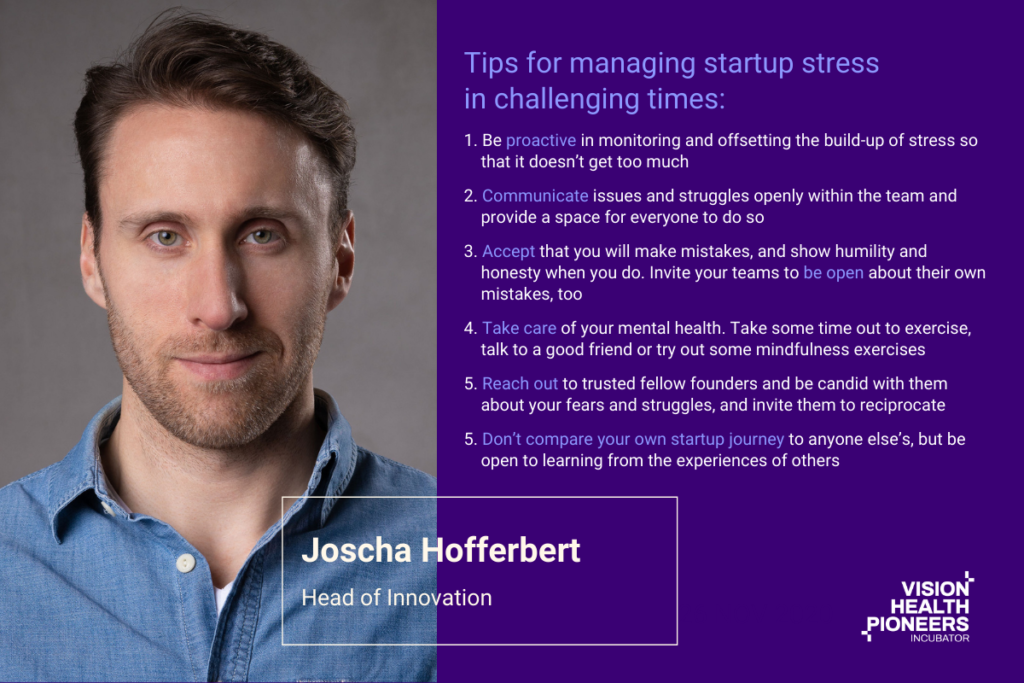
At Vision Health Pioneers, our own team features an expert primed to examine and understand group dynamics. Boasting a degree in psychology and neuroscience, with the added bonus of being passionate about innovation and nurturing fledgling startups in the healthcare world, Joscha Hofferbert, as one of the initiators of the program, s uniquely poised to make astute observations on how to create a team strong enough to weather any storm.

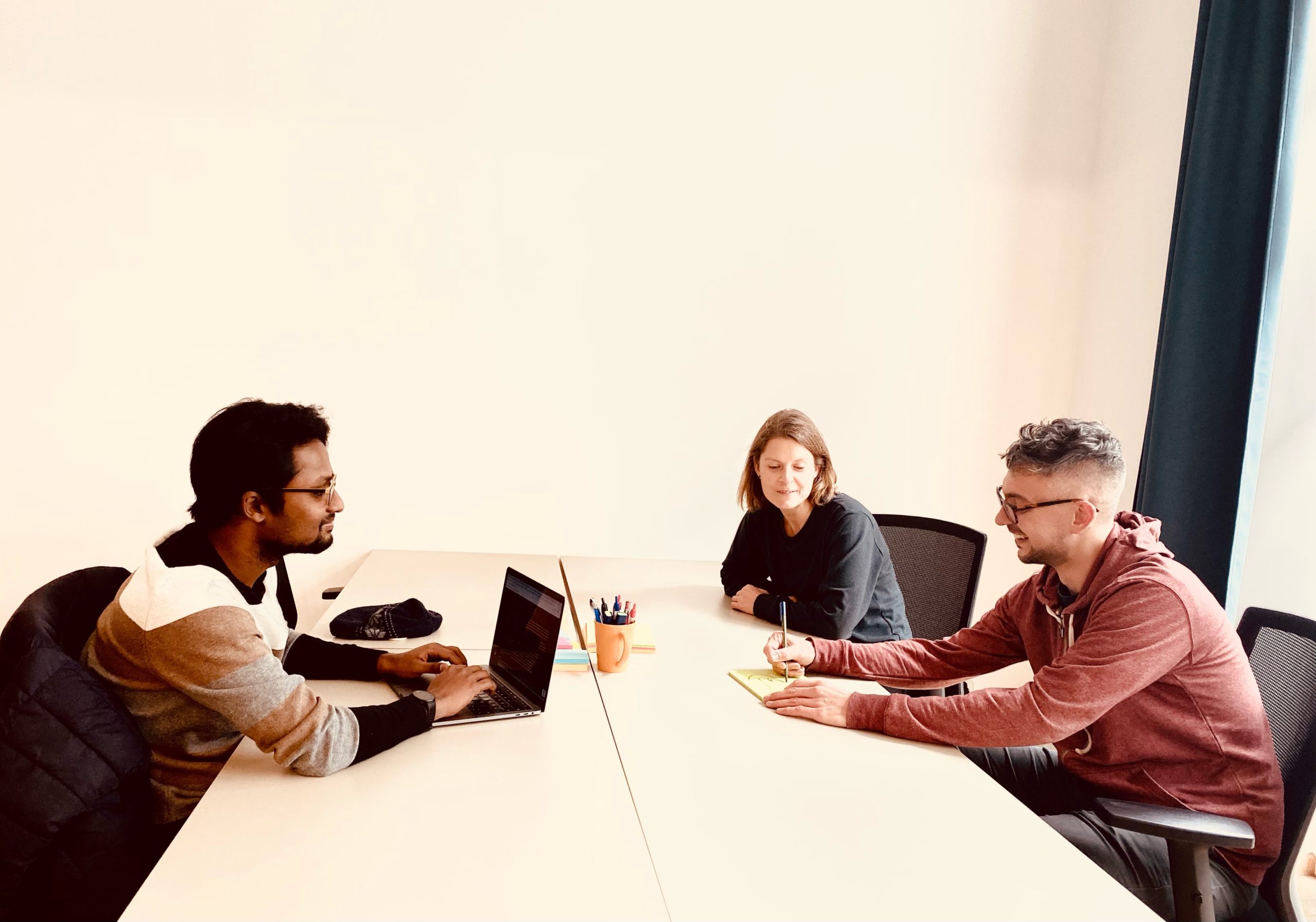
Batch 2 startup Alma understand the importance of communication

Joscha has observed that a startup team’s communication and collaboration style is intrinsic to their success, just as a shared purpose is a key success factor.

In fact, the founder of Berlin’s Hacking Health—who also serves as Vision Health Pioneer’s Head of Innovation—reports his own surprise in realizing just how crucial team dynamics are through the course of batch 1.

“Within the first months, we discovered that team building is way more important than we thought it was. We did not expect (bad team dynamics) to be such a killer,” he said.


This observation is grounded on several real-life examples. The teams that flourished were made up of individuals who worked well together: They were united under a shared mission and were able to communicate with each other, even when things got a bit fraught. They also trusted each other enough to be able to work with autonomy and creativity. Meanwhile, teams that did not present a united front were not strong enough to withstand the challenges as and when they cropped up. It also became clear just how essential having an objective observer was in identifying gaps, issues and potential threats that teams most often realize far too late.

“Teams quit when haven’t agreed on a shared mission, and we had to replace members. There were instances where it didn’t work out. That’s when we realized the importance to place an even stronger focus on team coaching,” he says.

Ingredients for the perfect team

Joscha gives a couple of examples of the teams that overcame challenges owing to the extent to which they were fueled by a shared vision. He outlines what it was about them that helped them flourish. These included MySkills, a startup creating digital solutions for sufferers of Borderline Personality disorder that has gone from strength since it joined the program, and beyond.

“At first, we were a bit skeptical about MySkills, because they are a couple,” Joscha recalls, describing how psychology professional Anne Florin and product designer Patrick Hartwig joined forces to create a product supporting mental health patients with the personality disorder, with a user-friendly app replacing the unwieldy documents. In hindsight, Joscha reflects that the fact that they were a couple with a shared dream was something that highly contributed to their success.

“They’ve both been working in different fields, and they really complement each other. And they are united by a common goal and perspective,” he adds. This alignment in purpose and mission, alongside the fact that the couple had already been working on the product for years alongside their jobs, made them a winning team. That was one factor that led to their success. Another was how the team was set up, with each member clear on the contours of their tasks and responsibilities. 

Other examples of teams who worked well owing to shared vision include startup Mila.Health, whose founders Jonas Keil, Ines Räth and Catalina Turlea aligned on the vision of normalizing the act of seeking out mental health support in professional contexts. Like MySkills, the team were far from strangers when they began work on their project together, having in the past worked together on a number of projects already. This made them very aware of how to work well as a unit. Likewise, their clear mission and great distribution of responsibilities was a key ingredient to their success.


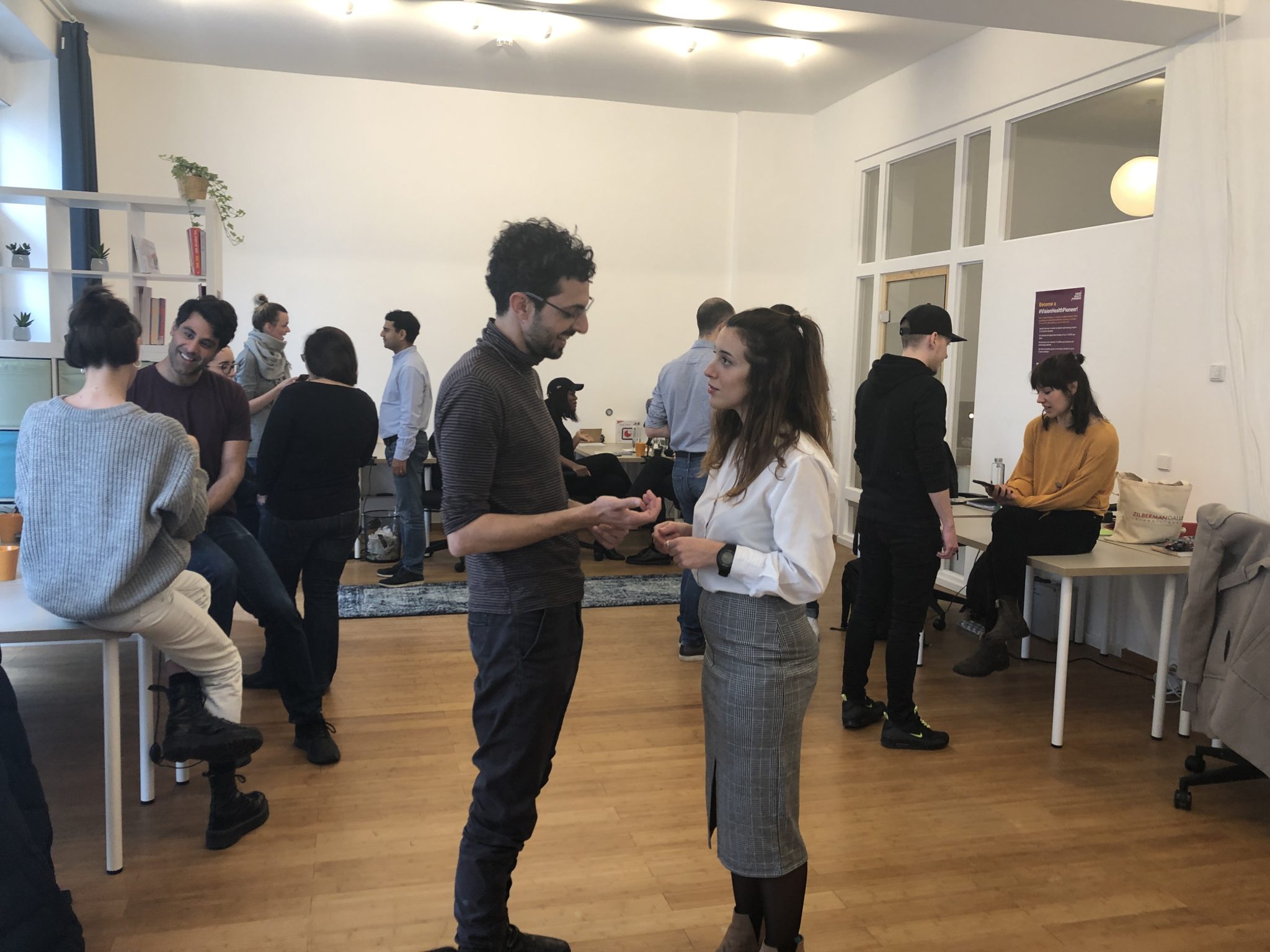
Team building became all the more complex when meeting virtually was our only option (picture from 02/2020) 

Advosense is another example of a
team that thrived thanks to
a common mission:
Martina Viduka, Erin Webb and
Grace-Anne Marius devoting
themselves to the work of
revolutionizing geriatric care.

This shared vision is what helped many teams see through all the challenges of the year, just as teams in which its members understood each other well proved successful. Meanwhile, teams that suffered could not communicate or address issues, and were especially challenged when the fear of speaking out prevented important issues from being addressed, either within the group or with the help of a coach.

“Soft skills are really important,” says Joscha, “teams have to have a common understanding of each other and trust each other,” he says, adding that all the teams that had flourished in batch 1 had been made up of individuals who knew each other well before the program started.

Looking forward to batch 2

Naturally, these are all observations the team at Vision Health Pioneer’s is taking to heart as our new batch starts to settle in. Learnings from batch 1 have encouraged us to improve our own resources around team building, and we will be placing a larger emphasis on creating exercises and events to ensure we are doing everything we can to foster open communication and empathy across teams, even or especially with events taking virtual format. We think it is particularly important to do so in times in which we can’t be as physically present as we’d like, but in which it is especially crucial to foster a common understanding.

The incubator has already implemented a number of strategies to help strengthen and develop teams and which can help foster a common alignment on its mission and purpose. These include a monthly team coaching session with Joscha, open hours for individuals, individual personality and capability coaching and leadership coaching. We will also make sure to provide structured feedback on team development and dynamics.

All of these additions to the Vision Health Pioneers repertoire of support structures will help develop all of our teams such that each entrepreneur is equipped to work at their best, regardless of external stressors or circumstances. 

“And it’s important to do these team-building exercises that aren’t just about work,” says Joscha. “Going for a walk, going for coffee, getting lunch—it’s really important in times like these.”

But of course, the promise of shared quality time as a team in whatever format that is available through and hopefully beyond social distancing times are just one part of the puzzle in building the best teams. What’s most important is a shared vision, clear and open distribution of roles and constructive communication. These ingredients are all essential in making the dream teams work.